

Leading Customer Experience with Clarity, Data, and AI: A Conversation with Sandra Samuel, Head of Customer Service at Ninja Van
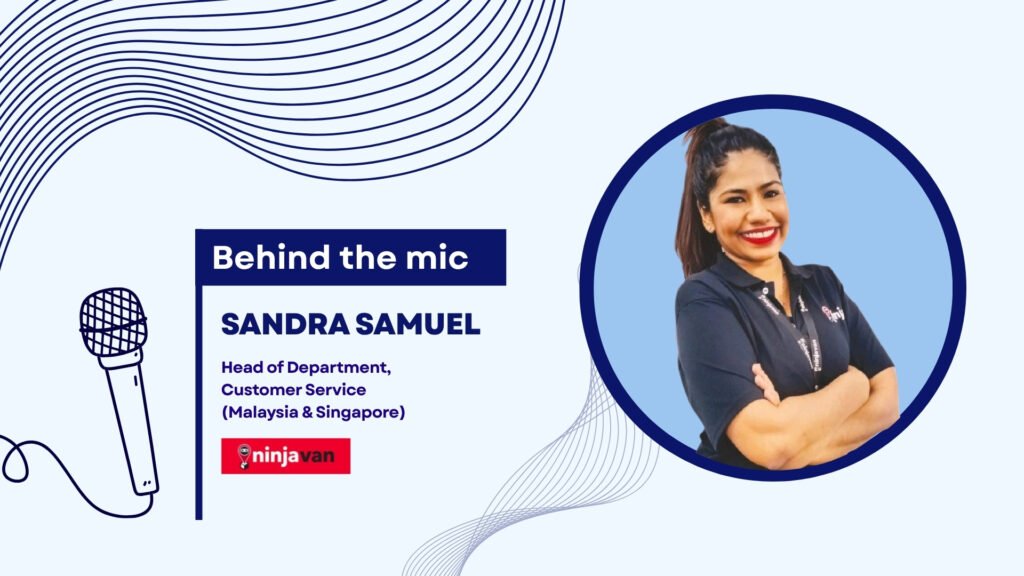
Sandra Samuel is a Customer Experience leader with over 18 years of experience, including 14 years in leadership roles across Malaysia and Singapore. She currently leads Customer Service operations at Ninja Van, where she has been instrumental in stabilising and scaling multi-market operations through strong system design and operational clarity.
Known for her approach to simplifying complexity, Sandra focuses on building decision-driven organisations – where performance is shaped by clear inputs, aligned expectations, and structured thinking rather than reactive execution.
Her work centres on transforming CX operations into scalable, resilient systems, especially in environments navigating rapid growth, operational instability, and increasing AI adoption.
We had the privilege of speaking with Sandra Samuel, Head of Customer Service for Malaysia & Singapore at Ninja Van, to gain her insights on building scalable customer service operations. Here’s her perspective on the strategies and leadership principles shaping the future of customer experience.
Q1. What motivated you to pursue a career in customer experience, and what key experiences shaped your journey into leading customer service operations across Malaysia and Singapore?
I’ve always believed customer service is one of the best places to understand a business.
Every customer enquiry tells a story – not just about the customer, but about the processes, systems and decisions behind the experience. That curiosity led me beyond managing customer interactions and into improving operations, workforce planning and process design.
Today, as the Head of Customer Service for Malaysia and Singapore, my focus is no longer just on resolving issues. It’s about building systems that prevent them, while creating an environment where teams have the clarity and tools to make better decisions every day.
Great customer experience doesn’t begin with the customer – it begins with the operation behind them.
Q2. How have you leveraged emerging technologies such as AI, automation, and data analytics to enhance customer service operations and improve customer experience?
When AI became more accessible, my first instinct was to automate as much as possible. What I quickly realised, however, was that technology couldn’t solve fragmented processes or unclear decision-making – it simply exposed them faster.
That shifted my approach. Before introducing automation, we focused on simplifying workflows, creating a single source of truth and ensuring our data was reliable. Only then could AI and automation become meaningful enablers rather than temporary fixes.
Today, I use AI less as a replacement for people and more as a collaborative thinking partner. It helps challenge assumptions, explore different perspectives and accelerate problem-solving, while data analytics provides the insights needed to make informed operational decisions. Together, they allow our teams to spend less time gathering information and more time acting on it.
AI doesn’t replace judgement. It amplifies it.
Q3. What are some of the most significant challenges you've faced while scaling customer service operations across multiple markets, and how did you overcome them?
One of the biggest challenges wasn’t managing different markets – it was ensuring that different teams were making decisions based on the same principles. As organisations grow, it’s easy for each team to develop its own processes, reporting methods and ways of working. Over time, that creates inconsistency and makes scaling increasingly difficult.
My approach has always been to standardise the fundamentals without removing the flexibility teams need to respond to local operational requirements. By establishing a single source of truth, defining clear ownership and simplifying operational workflows, we created greater consistency while still allowing each market to adapt where necessary.
I’ve learned that scaling isn’t about adding more layers of management or more processes. It’s about creating systems that make the right way of working the easiest way of working.
Scaling isn’t about getting bigger. It’s about becoming simpler.
Q4. What role do customer insights and operational data play in designing scalable customer experience systems, and how do you gather and incorporate these insights effectively?
Customer insights are one of the most valuable sources of operational intelligence because customers experience our business exactly as it operates—not as we intend it to operate.
Rather than viewing customer feedback as isolated incidents, I look for patterns. Repeated enquiries, recurring complaints and operational trends often reveal opportunities to improve processes, simplify customer journeys or remove friction altogether. When these insights are combined with reliable operational data, they help us make decisions based on evidence rather than assumptions.
For me, data should never exist for reporting alone. Its purpose is to drive meaningful action, whether that’s improving a process, supporting our teams or creating a better experience for our customers.
The best customer insights don’t tell you what’s wrong with your customers. They tell you what’s wrong with your operation.
Q5. Can you describe a specific instance where redesigning a customer service process or operational system significantly improved performance or customer satisfaction?
One of the biggest lessons I’ve learned is that complexity often disguises itself as productivity. When I reviewed our operations, I found multiple reports capturing similar information in different ways, requiring significant manual effort but providing little additional value.
Instead of adding another reporting layer, we stepped back and redesigned the process from the ground up. We consolidated reporting into a single source of truth, eliminated duplicate work and automated wherever possible. This gave leaders faster access to reliable information while allowing frontline teams to spend more time supporting customers instead of maintaining spreadsheets.
The biggest improvement wasn’t just operational efficiency—it was decision quality. With clearer data and simplified processes, teams were able to identify issues earlier, respond more confidently and focus their energy on continuous improvement rather than administrative work.
Every process should earn the right to exist.
Q6. Could you share a success story where your leadership transformed a complex or unstable customer service environment into a scalable and high-performing operation?
One of the most defining moments in my career came during a period of significant organisational restructuring, when I inherited multiple functions across Customer Service, Quality Assurance, Workforce Planning and Shipper Support within a very short period of time. Rather than recreating the previous structure, I saw it as an opportunity to redesign how we worked.
We simplified processes, consolidated fragmented reporting, established a single source of truth and focused on giving leaders greater visibility instead of more spreadsheets.
The goal wasn’t simply to improve efficiency. It was to build a system that could continue performing consistently, regardless of organisational changes.
The experience reinforced a lesson that continues to shape my leadership today: sustainable transformation isn’t achieved by working harder; it’s achieved by making work simpler, clearer and easier to scale.
Leadership isn’t measured by stability. It’s measured by what you build when stability disappears.
Q7. How do you balance the adoption of AI and automation with the need to maintain human judgment, accountability, and empathy in customer interactions?
I don’t see AI and human judgment as competing with each other. I see them as serving different purposes. AI is excellent at processing information, identifying patterns and accelerating routine tasks. People, however, provide context, accountability and empathy, especially when decisions have a real impact on customers.
For me, the goal has never been to replace human decision-making. It’s to remove repetitive work so our teams can focus on conversations, critical thinking and solving more meaningful problems. The best customer experiences still come from people who understand the situation, take ownership and make thoughtful decisions.
As AI continues to evolve, I believe leadership becomes even more important. Technology should enhance human capability, not diminish responsibility. The moment we rely on AI to replace accountability, we lose the very qualities that build trust with customers.
Automation should remove repetitive work, not human accountability.
Q8. What best practices have you implemented to build decision-driven customer experience teams and ensure clarity, ownership, and operational alignment across the organization?
One of the biggest shifts I’ve made is moving conversations away from reporting and towards decision-making. Teams shouldn’t spend most of their time compiling information—they should spend it understanding what the information is telling them.
To achieve this, we’ve focused on creating a single source of truth, defining clear ownership and simplifying the way information flows across the organisation. When everyone works from the same data and understands their role in the bigger picture, decisions become faster, more consistent and more aligned.
I’ve also learned that clarity is contagious. When leaders have clarity, they communicate better. When teams have clarity, they take greater ownership. That creates an environment where accountability happens naturally rather than through constant oversight.
Clarity creates ownership. Ownership creates performance.
Conclusion
Sandra Samuel’s insights reinforce a powerful message: exceptional customer experience is built on operational excellence, thoughtful leadership, and a clear sense of purpose. Throughout this conversation, she highlights that AI, automation, and data are most impactful when they simplify complexity, empower people, and support better decision-making rather than replace human judgment. Her philosophy of creating scalable systems, fostering accountability, and leading with clarity offers valuable lessons for organizations navigating the evolving landscape of customer experience.
We extend our sincere thanks to Sandra Samuel for sharing her expertise and strategic perspectives in this edition of Behind the Mic. As a distinguished speaker at the Conversational AI & Customer Experience Summit Asia 2026, she continues to inspire CX leaders with her practical approach to building resilient, customer-centric operations.
“Stay tuned for more conversations with industry pioneers shaping the future of AI, customer experience, and business transformation. If Sandra Samuel’s insights resonated with you, don’t miss the opportunity to hear from more global CX and AI leaders at the 5th Annual Conversational AI & Customer Experience Summit Europe 2026, taking place on 28–29 October 2026 in Munich, Germany.”
Join us at Altrusia Global Events as we embark on a transformative journey
Newsletter
Copyright © 2026 Altrusia Global Events Pvt Ltd