

Building Trusted AI for the Future of Healthcare with Shigeto Miyamoto, APAC Digital & AI Transformation | AI Governance | Japan–ASEAN Business
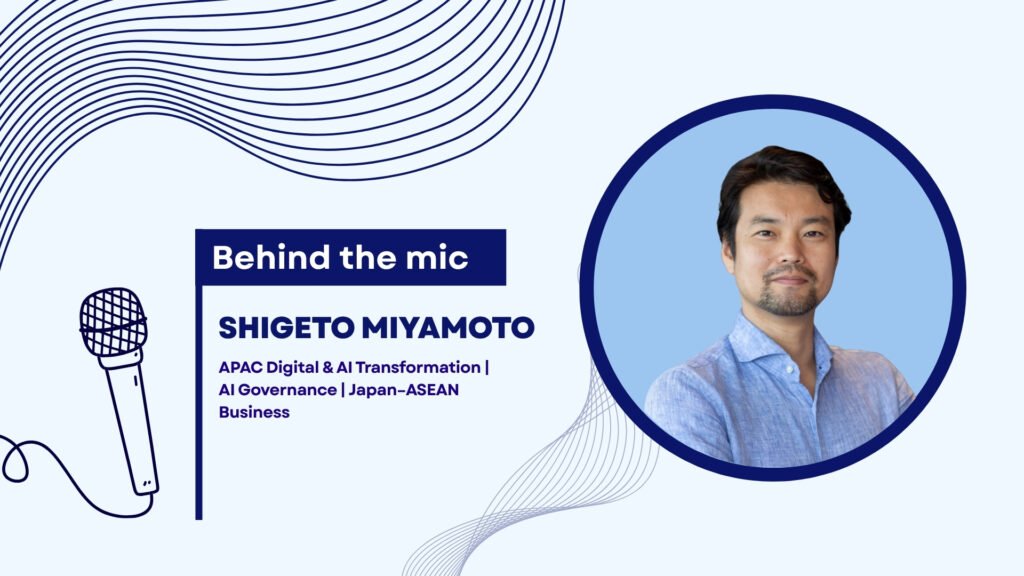
Shigeto Miyamoto is a healthcare and digital transformation leader focused on commercial innovation across Asia, including Japan, Singapore, and broader regional markets. He works at the intersection of strategy, marketing, and technology, with particular emphasis on AI, LLMs, analytics, and pharmaceutical commercial digitalization.
He has led cross-regional initiatives in digital innovation and customer engagement, and is recognized for applying emerging technologies to practical business transformation. Beyond corporate leadership, he has contributed as a thought leader and speaker at international industry forums across Asia.
Shigeto has also worked with healthcare executives on innovation strategy alongside faculty from INSEAD, helping senior leaders translate emerging technologies into practical organizational change and commercial impact.
In this edition of Behind the Mic, we had the opportunity to speak with Shigeto, a speaker at the Conversational AI & Customer Experience Summit Singapore 2026, about the evolving role of AI in healthcare, digital transformation across APAC, and the importance of building trusted, customer-centric solutions.
Q1. What motivated you to pursue a career in healthcare and digital transformation, and what key experiences shaped your journey across Asia's diverse markets?
What drew me into healthcare was realizing that data and technology can directly impact patient outcomes. APAC is incredibly diverse with different levels of access and different levels of digital maturity that creates both complexity and opportunity. Working across markets like Japan, Southeast Asia, and China shaped how I think about this space. Today, I focus on balancing local market understanding with scalable digital approaches.
Q2. How have you leveraged emerging technologies such as AI, large language models, and advanced analytics to drive innovation and customer engagement within the healthcare sector?
We don’t see AI or large language models as just efficiency tools, we see them as engines for transforming customer experience. For example, we use them to personalize content for healthcare professionals, extract insights from unstructured data, and optimize commercial engagement strategies. But the technology itself isn’t the differentiator — it’s how well you embed it into real business processes.
Q3. What are some of the most significant challenges you've faced while leading digital transformation initiatives across multiple APAC markets, and how did you overcome them?
There are a few consistent challenges: regulatory differences across markets, varying levels of digital maturity, and fragmented data landscapes. To address these, we focus on modular architectures, regional centers of excellence, and a use-case-driven approach. At the end of the day, it’s about finding the right balance between standardization and local flexibility.
Q4. What role does customer and stakeholder insight play in shaping digital solutions, and how do you gather and incorporate those insights effectively?
Customer insight is absolutely critical, I’d say it determines the majority of success in digital initiatives. We combine quantitative data, like CRM and behavioural data, with qualitative input, like direct feedback from healthcare professionals. But collecting data isn’t enough, the real value comes from translating those insights into actionable decisions.
Q5. The healthcare industry often faces unique regulatory and operational complexities. What strategies have you found most effective in translating emerging technologies into practical business outcomes while navigating these challenges?
In healthcare, it’s not about what you can do — it’s about what you should do. We take a “compliance by design” approach: involving legal and medical teams early, and building solutions that are compliant from the start. We also start small, with pilot programs, before scaling. Innovation and regulation don’t have to conflict — you just need to design for both.
Q6. How has AI or digital innovation helped identify challenges and drive improvements in customer engagement or commercial performance?
In one project, we used AI to analyze engagement patterns with healthcare professionals. That allowed us to identify key drivers, redesign our segmentation, and tailor our engagement strategies — resulting in clear improvements in engagement and conversion metrics. What really mattered was how quickly we could turn insights into action.
Q7. Healthcare organizations are increasingly exploring AI adoption. What common misconceptions or barriers do you see, and how can organizations address them successfully?
There are a couple of common misconceptions: that AI is just about automation, and that you need perfect data to start. In reality, AI is more about supporting decision-making, and you can create value even with imperfect data. Success usually comes from starting with clear use cases, involving business teams early, and scaling from small wins.
Q8. How do you approach prioritizing digital innovation initiatives while ensuring alignment with business objectives, customer needs, and market realities?
We typically prioritize initiatives based on business impact, feasibility, customer value, and scalability — a value-versus-feasibility matrix, combined with a clear roadmap. Plus just as important, prioritization is also about deciding what not to do.
Q9. How do you collaborate with cross-functional teams such as commercial, marketing, technology, data, and healthcare stakeholders to successfully implement innovation at scale?
Collaboration comes down to building a common language across teams. You need people who can bridge business and technology, and you need shared KPIs. A key part of leadership here is acting as that bridge — translating between functions to align everyone toward the same goal.
Q10. How do you balance rapid advancements in AI and digital technologies with the need for trust, compliance, and responsible use within the healthcare industry?
As AI advances, trust becomes a real differentiator. We focus on strong data governance, transparency, and principles around responsible AI. It’s not just about speed — it’s about building solutions people can trust.
Q11. Looking ahead, how do you see AI reshaping customer engagement, decision-making, and commercial operations within healthcare over the next five years?
Over the next five years, AI will significantly reshape how we operate. We’ll see highly personalized customer engagement, more AI-supported decision-making, and more advanced omnichannel commercial models. But the most important shift will be toward a hybrid model, where humans and AI can work together.
Q12. How do you stay updated with the latest trends and developments in AI, healthcare innovation, customer engagement, and commercial digitalization?
I stay currently updated through a mix of internal and external networks, and by staying close to real projects. I also pay attention to what startups and tech companies are doing. But ultimately, the most important thing isn’t just to learn, it’s to experiment and apply those learnings in practice.
Conclusion
Across these questions, a few threads run consistently through Miyamoto’s thinking. He keeps returning to the idea that AI’s value isn’t in the tool but in how deliberately it gets embedded into a business process — and that trust and compliance aren’t friction to work around, but something designed in from the start. His read on APAC as a region of genuine contrasts, not a single market, runs under nearly every answer, and explains why modular, use-case-first approaches keep surfacing as his default rather than a top-down blueprint. And his outlook for the next five years isn’t AI replacing judgment — it’s a hybrid model, where the technology does the scale work, and people still own the call.
“Stay tuned for more conversations with leaders shaping the future of AI, healthcare, and digital transformation. Discover more insights from global innovators at the upcoming Conversational AI & Customer Experience Summit Europe 2026.”
Join us at Altrusia Global Events as we embark on a transformative journey
Newsletter
Copyright © 2026 Altrusia Global Events Pvt Ltd