

Designing Customer Experiences Around Human Needs : Wei Jie Kwan, VP of customer success and business insights at NETS on Behind the mic
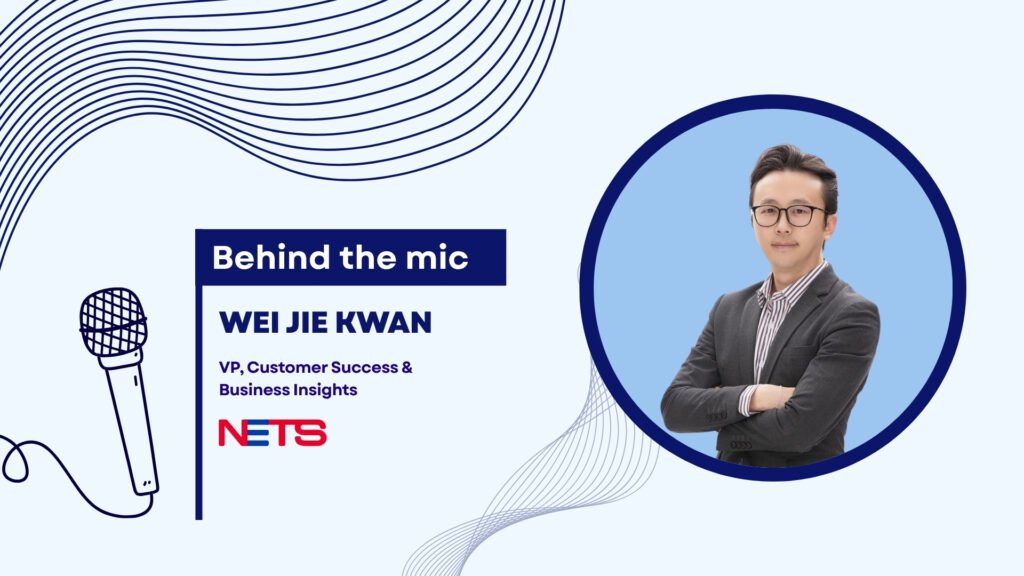
Wei Jie Kwan a customer-centric transformation leader with over 15 years of progressive experience driving enterprise-wide impact across healthcare, payments, and aviation industries. Proven track record in leading Customer Experience (CX) strategy, digital transformation, design thinking, AI implementation and data-driven business optimization across B2B, B2C, and B2B2C environments.
Skilled in building agile, future-ready teams and aligning CX outcomes with business growth, customer retention, revenue expansion, cost optimization, transformation, innovation, and competitive advantage. A sought-after keynote speaker and thought leader in CX, service transformation, and sustainability, with a reputation for turning customer insights into strategic levers for enterprise success.
During this edition of Behind the Mic, Wei Jie Kwan shares his experiences and perspectives on customer experience, AI, business insights, and the importance of keeping human needs at the centre of transformation.
Q1. What motivated you to pursue a career in customer experience and business transformation, and what key experiences shaped your journey across the healthcare, payments, and aviation industries?
I have never deliberately set out to build a career in customer experience. What attracted me throughout my career was understanding people and engaging people.
I have been fortunate enought to work across healthcare, aviation, and payments industries, and while they are very different, they all have one thing in common that customers remember how you make them feel during important moments.
Healthcare taught me the importance of empathy and trust. Aviation taught me the importance of consistency and building that experience that matters. Payments taught me that trust can be built or lost in a matter of seconds.
Over time, I realised that customer experience isn’t just about service. It is about understanding what customers are trying to achieve and designing experiences that help them get there with as little friction as possible. That is what continues to motivate me today.
Q2. How have you leveraged emerging technologies such as AI, data analytics, and digital platforms to enhance customer success and deliver better business outcomes?
AI and analytics are valuable because they help us understand customers better and make better decisions faster.
In the past, we relied heavily on surveys, feedback forms, and customer complaints to understand what was happening. Today, we have access to much richer signals. We can analyse customer interactions, identify emerging trends, detect friction points, and sometimes even anticipate issues before customers experience them.
The real opportunity isn’t automation for the sake of automation. It is using technology to make experiences simpler, more relevant, and more proactive.
If a customer never had to call because we resolved the issue before they were affected, that is a much better outcome than responding quickly after the fact.
Q3. What are some of the most significant challenges you've faced while leading enterprise wide customer experience transformation initiatives, and how did you overcome them?
The biggest challenge has never been technology.
It is often about getting people across different functions to rally behind the same customer outcome.
Most organisations are structured around departments, but customers don’t experience organisations that way. They experience that one journey and view the organisation as one single touchpoint.
I learned that transformation becomes much easier when people can see the problem through the customer’s eyes. That’s why I spend a lot of time on customer journeys, customer stories, and customer insights. With the insights, it would help different departments see how they can all work towards the same goal.
Once everyone understands the impact they are having on customers, discussions shift from “whose responsibility is this?” to “how do we solve this together?”
Those are the moments where real transformation happens.
Q4. What role do customer insights and business intelligence play in shaping customer success strategies, and how do you gather and incorporate these insights effectively?
Customer insights sit at the heart of almost every decision I make.
One thing I learned over the years is that customers don’t always tell us directly what went wrong. Often, the answer emerges when you connect different pieces of information together.
I like to combine multiple sources, surveys, complaints, operational data, frontline feedback, contact centre interactions, and behavioural trends.
A survey might tell you what customers think. Operational data tells you what customers are doing. Frontline employees tell you why it is happening. When you put all three together, that is when the real insights emerge.
The goal is not collecting more data. The goal is understanding customers better. With these insights, that is when business decisions can be made more successfully and more relevant to the customers.
Q5. Can you describe a specific instance where customer insights or data analytics helped identify a critical opportunity and led to measurable business impact?
One lesson I have learned is that customers often tell us where the problem is, but not necessarily what the root cause is.
In one initiative, we noticed repeated complaints appearing across several channels. Initially, they looked like unrelated issues.
When we analysed complaint data, customer contacts, and operational performance together, we realised they all pointed back to the same underlying friction point within a customer journey.
Fixing that root cause not only improved customer satisfaction but also reduced operational effort and repeat contacts.
The biggest insight was that sometimes the strongest opportunities are hidden in plain sight. You just need to connect the dots.
Q6. Could you share a success story where your leadership in customer experience or digital transformation significantly improved customer satisfaction, business performance, or organizational growth?
One of the most meaningful transformation initiatives I had the privilege to be part of was during my time in healthcare, where we challenged a long-held assumption about how people viewed hospitals.
Traditionally, many Asian families see hospitals as places associated with illness, treatment, and recovery thus the avoidance unless necessary. Yet childbirth is one of life’s most joyful and memorable milestones. We asked ourselves a simple question: Why should the experience of welcoming a new baby feel like a hospital stay?
Instead of designing around the patient alone, we redesigned the experience around the broader ecosystem of the mother, father, family members, and even close friends who would be part of that journey.
This led to the introduction of a Family Suite concept, which moved beyond the traditional hospital room model. We looked at the entire customer journey from pre-admission, delivery, visitation, recovery, and discharge, identifying moments that mattered most emotionally. The goal was to create an environment where families could celebrate, bond, and create memories together during one of the happiest moments of their lives.
To achieve this, we brought together clinical teams, operations, facilities, service staff, and business stakeholders to reimagine the experience holistically. The transformation wasn’t just about upgrading a room. It was about shifting the mindset from delivering healthcare services to designing meaningful family experiences.
The results were encouraging. We saw strong demand for the concept, positive patient and family feedback, and increased differentiation in a highly competitive healthcare market. More importantly, it changed the internal conversation. Teams started looking beyond clinical outcomes and asking how we could better serve the emotional and practical needs of patients and their loved ones.
What stayed with me most was the realization that customer experience is not always about fixing problems. Sometimes it is about understanding the emotions behind a journey and creating experiences that people will remember for the rest of their lives.
That experience continues to shape how I approach customer experience today. Whether in healthcare, aviation, or payments, I believe the best innovations happen when we stop focusing solely on transactions and start designing around human needs, emotions, and moments that matter.
Q7. How do you collaborate with cross-functional teams such as customer success, product, technology, operations, and business leaders to deliver seamless customer experiences?
One thing I often remind my teams is that customers don’t care about our organisational chart.
They don’t distinguish between product, operations, technology, or customer service. They simply experience the outcome.
Because of that, I try to create a shared view of the customer journey and bring everyone around the same table.
I found that when teams focus on customer outcomes rather than departmental objectives, collaboration becomes much easier.
My role is often less about having the answers and more about bringing together the right people to solve the right problems.
Q8. How do you balance AI-driven automation and data-led decision-making with the need to maintain trust, empathy, and meaningful customer relationships?
I don’t see AI and empathy as opposing forces.
In fact, AI can create more space for empathy when used correctly.
AI is excellent at identifying patterns, automating repetitive work, and helping us respond faster. But there are moments in a customer’s journey where people simply want reassurance, understanding, or human judgement.
That is why I believe the future isn’t AI versus humans. It is AI and humans working together.
The biggest misconception many have is that customers expect AI to behave like a human. However, they actually expect it to be just useful. Trust is built when AI makes life easier, while people continue to provide empathy and judgement when it matters most.
Q9. How do you stay updated with the latest trends and developments in customer experience, AI, business insights, digital transformation, and service innovation?
I read a lot, attend industry events, and enjoy learning from other practitioners, but honestly, some of the most valuable insights come from customers and frontline employees.
It is easy to get caught up in the latest technology trends. What’s harder, and more important, is understanding whether those innovations solve real customer problems.
Whether it’s attending conferences, speaking with industry peers, listening to customer calls, or observing how people interact with products and services, I believe learning can come from anywhere.
The moment we think we already know what customers want is usually the moment we stop learning. I strongly encourage everyone to stay curious and keep asking what customers want and more.
Conclusion
Kwan Wei Jie’s perspective on customer experience is ultimately grounded in a simple principle: technology, data, and transformation only create real value when they make experiences more meaningful for people.
From connecting customer insights across multiple touchpoints to bringing cross-functional teams together around shared customer outcomes, his approach highlights the importance of looking beyond individual departments, transactions, or technologies. AI, in particular, can help organisations identify patterns, remove friction, and create more proactive experiences, while human empathy and judgement remain essential when customers need understanding and reassurance.
His experiences across healthcare, aviation, and payments have reinforced the same lesson in different ways — the moments customers remember are often the ones that make them feel understood. As customer expectations and technology continue to evolve, staying close to those moments, listening to customers and frontline teams, and remaining curious may be what keeps customer experience transformation moving forward.
At the heart of it all, the goal is not simply to adopt what is new, but to keep asking a more important question: Does this make the customer’s experience better?
“The conversation around customer experience, AI and digital transformation continues at the 5th Annual Conversational AI & Customer Experience Summit Europe 2026 in Munich.
Stay tuned for the next edition of Behind the Mic, where we’ll bring you more insights, experiences and perspectives from industry leaders shaping the future of customer experience.”
Join us at Altrusia Global Events as we embark on a transformative journey
Newsletter
Copyright © 2026 Altrusia Global Events Pvt Ltd