

AI with Purpose: Dr Jaslyin Qiyu from Cigna Healthcare on Building Trust, Innovation, and Exceptional Customer Experiences
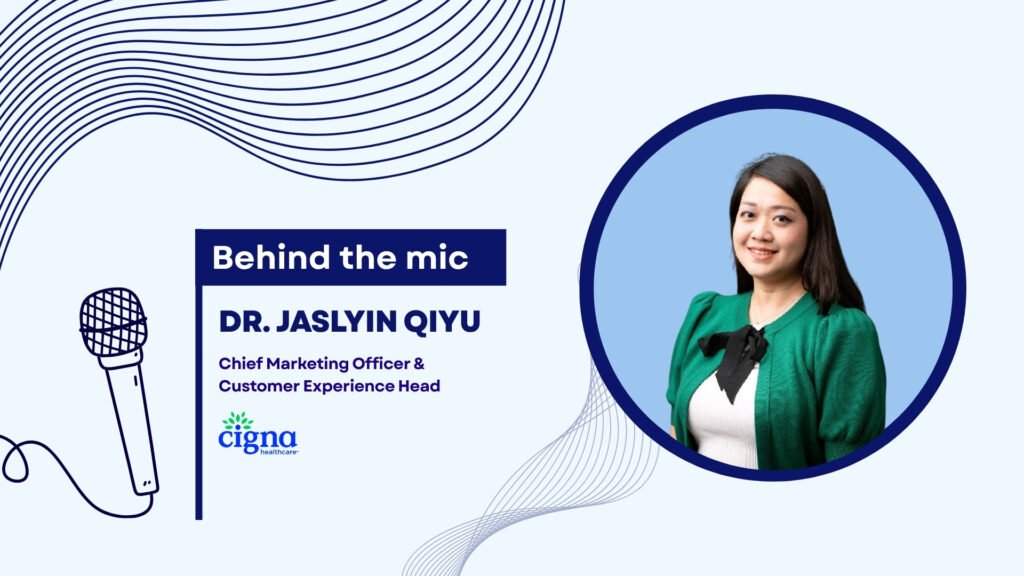
Dr Jaslyin Qiyu is Chief Marketing Officer and Head of Customer Experience Singapore and Australia for Cigna Healthcare, where she leads brand strategy and customer experience initiatives across the region.
With over 20 years of B2B and B2C brand, marketing and communications experience across diverse industries, she specializes in brand building, customer experience management, change management, MarTech and AI adoption strategy, content strategy, multi-channel performance marketing, and mobile engagement and optimization.
Prior to joining Cigna Healthcare, Jaslyin founded and led her own marketing consultancy. She has managed regional marketing teams across Asia Pacific for global MNCs including Citibank, EY, JLL, Kantar, Credit Suisse, and State Street, where she drove marketing transformation, built go-to-market strategies, and established high-performing marketing teams from the ground up.
We had the opportunity to engage with Dr Jaslyin Qiyu on a range of topics spanning AI, customer experience, marketing strategy, leadership, and digital transformation to understand her perspective on the industry’s evolving future.
Q1. What motivated you to pursue a career in marketing and customer experience, and what key experiences shaped your journey into leadership roles across multiple industries?
My path wasn’t linear by design. It was shaped by pattern recognition. Across Citibank, EY, Credit Suisse, JLL, Kantar, and State Street, I kept noticing the same gap: companies treated marketing and customer experience as separate functions when customers experience them as one continuous relationship. That observation, repeated across financial services and consulting, is what pulled me toward CX specifically rather than marketing alone. Leadership roles came from being willing to sit in that gap and build the connective tissue, which is also why I eventually founded MAMC, to formalize that cross-functional view as a practice rather than just a personal habit.
Q2. How have you leveraged emerging technologies such as AI, MarTech, and data analytics to enhance customer experience and marketing effectiveness?
I treat AI adoption as a discernment problem, not a tooling problem. What I call closing the “discernment gap” is between having access to AI and knowing when and how to deploy it responsibly. Concretely, I’ve built decisioning systems with human-in-the-loop design, for example, a MAS-compliant advertising decisioning system for a banking client. I’ve also developed our own AI Visibility Index methodology to help brands understand how they show up in AI-mediated search, and an AI Adoption Maturity Assessment tool built around a People-Process-Platform framework, so technology adoption is measured against organizational readiness, not just feature availability.
Q3. What are some of the most significant challenges you've faced while driving customer experience and marketing transformation initiatives, and how did you overcome them?
The most persistent challenge is what I call “pilot purgatory”: organizations launch AI or CX pilots that never graduate to scaled, governed deployment because nobody owns the transition from experiment to infrastructure. I overcame this by insisting that knowledge governance comes before tool selection. If the underlying data and process aren’t ready, no platform fixes that. In regulated industries specifically, the challenge is trust: balancing innovation speed with compliance, which is why I build explainability statements and compliance decisioning workflows rather than just shipping faster.
Q4. What role does customer insight and feedback play in shaping brand strategy and customer experience programs, and how do you incorporate it effectively?
Insight has to inform brand strategy upstream, not just validate it after the fact. In my CX leadership work, I push for customer feedback loops that feed directly into messaging and journey design decisions, not just NPS dashboards that sit in a report. The discipline is making sure insight changes what gets built, not just how it gets explained afterwards.
Q5. What strategies have you found most effective in delivering consistent and meaningful customer experiences across multiple channels and touchpoints?
Consistency comes from a shared framework, not a shared style guide. People-Process-Platform is how I ensure every channel, whether a sales conversation, a digital touchpoint, or a service interaction, is operating off the same customer model. Tactically, that means RevOps-style alignment between marketing and sales so the customer doesn’t experience a handoff as a reset.
Q6.Can you describe a specific instance where data-driven insights helped identify a customer need or market opportunity and led to a successful business outcome?
Early in my career in banking, we were analyzing consumer behavioural data around offer redemptions and noticed a pattern that wasn’t immediately obvious: customers were disproportionately responsive to marketing offers on specific days of the week. The engagement lift wasn’t marginal. It was consistent enough across segments to suggest it wasn’t coincidental.
Rather than continuing to push offers uniformly across the week and diluting impact, we used that insight to design what became a structured flash sale mechanic, a high-value, time-limited offer on that particular day, running every other week. The cadence mattered as much as the timing: frequent enough to build anticipation, spaced enough to preserve the sense of exclusivity.
The results validated the data. Redemption rates climbed, customer engagement during those windows was measurably higher than standard campaign benchmarks, and the format created a rhythmic touchpoint that customers began to anticipate rather than ignore.
What I took from that experience was a principle I’ve carried ever since. Behavioural data rarely tells you what customers want, but it consistently reveals when and how they’re ready to engage. The strategy followed the signal, not the other way around.
Q7. Could you share a success story where your customer experience or marketing initiatives helped improve healthcare engagement, trust, or customer outcomes?
One of the first initiatives I led at Cigna Healthcare Singapore was the 15th anniversary campaign, a good example of brand-building and business outcomes working in tandem. Themed “15 Years of Connected, World-Class Healthcare,” it ran across media partnerships, digital out-of-home, and internal and external storytelling, with the deliberate intent of reframing market perception from insurance provider to dedicated healthcare partner. In a category where clinical coverage is increasingly comparable, trust and relevance are the real differentiators. The campaign gave us a credible platform to articulate that with conviction. While the primary goal was brand favorability and market presence among brokers, corporate clients, and prospects, it also generated incremental leads we hadn’t set as the headline target, a useful reminder that when brand work is done with clarity and consistency, commercial outcomes tend to follow even when they aren’t the lead metric.
Q8. Which methodologies or frameworks do you use to prioritize customer experience and marketing initiatives while ensuring alignment with business goals?
People-Process-Platform is my primary lens for sequencing: I won’t prioritize a platform investment ahead of a process or knowledge-governance fix it depends on. For brand and content prioritization specifically, I would use a GEO/AEO visibility tool to assess where visibility gaps actually are before deciding where to invest.
Q9. How do you collaborate with cross-functional teams such as marketing, technology, operations, and customer service to deliver seamless customer journeys?
I treat RevOps not as a sales-only function but as the connective infrastructure between marketing, technology, operations, and service. Practically, that means shared definitions on measurements of success and hand-off criteria, planning alignment and budget accountability rather than separate functional roadmaps that happen to intersect at the customer.
Q10. How do you balance the adoption of AI and automation with the need to maintain authenticity, empathy, and human connection in customer interactions?
This is exactly what “human-at-the-tail” design means to me. AI handles scale and speed, but a human owns the final judgment call wherever empathy, nuance, or trust is at stake. It’s a deliberate design choice, not a fallback: you decide upfront where automation stops and a person picks up.
Q11. What best practices have you implemented to ensure ethical, inclusive, and customer-centric marketing in an increasingly digital world?
I lean on explainability as a practice, not just a compliance requirement. If I can’t explain why an AI system made a recommendation, it shouldn’t get deployed. Inclusivity follows from the same discipline: testing messaging and decisioning systems for who they might be excluding before scaling them, not after.
Q12. How do you stay updated with the latest trends and developments in customer experience, marketing technology, and AI-driven engagement?
I stay close to practice rather than just reading trend reports. Building tools myself forces me to stay current with what the technology can actually do versus what it claims to do. I made the conscious decision to undertake MIT postgraduate courses in Digital Business Strategy followed by AI business strategy before Gen AI became popular, namely because I wanted to be anchored in the core foundations, limitations and potential of AI before I started experimenting with the tools. This is to ensure my knowledge is grounded in rigor rather than hype.
Conclusion
Dr Jaslyin Qiyu’s insights reinforce that the future of customer experience is not defined by technology alone, but by how thoughtfully organizations combine innovation with human judgment, governance, and purpose. From championing AI adoption with responsibility to bridging the gap between marketing and customer experience, her perspective highlights the importance of creating meaningful, trust-driven relationships at every customer touchpoint. As businesses continue to navigate an AI-powered future, her leadership philosophy serves as a valuable reminder that sustainable transformation begins with people, is strengthened by process, and is enabled by technology.
It was a privilege to have Dr. Jaslyin join us as a speaker at the Conversational AI & Customer Experience Summit Indonesia 2026. Through both her session at the summit and this Behind the Mic interview, she has shared invaluable insights into the future of AI-powered customer experiences and marketing innovation. We sincerely appreciate her contribution and look forward to continuing these important conversations.
“Stay connected with our Behind the Mic series as we continue to feature conversations with industry pioneers, thought leaders, and innovators, sharing the ideas, strategies, and real-world experiences shaping the future of AI, customer experience, and digital transformation.”
Join us at Altrusia Global Events as we embark on a transformative journey
Newsletter
Copyright © 2026 Altrusia Global Events Pvt Ltd