

Powering the Future of Education: John Ang on Technology Leadership at EtonHouse Education International Group Singapore
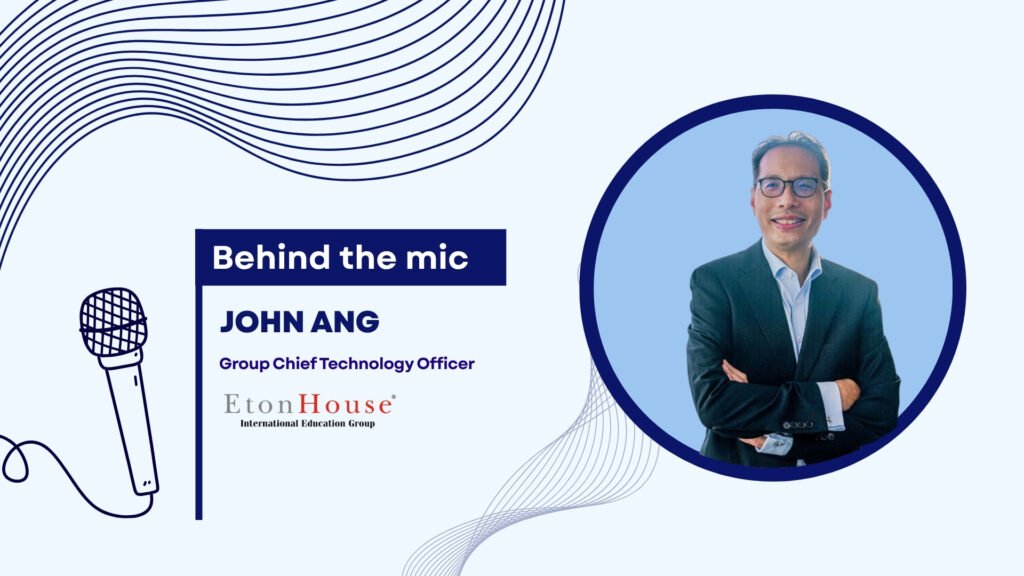
John Ang, serving as the Group Chief Technology Officer (GCTO) at EtonHouse Education International Group, is an experienced professional in technology.
His contribution to the transformation and modernization of technology at EtonHouse has been pivotal in integrating innovation with business strategies, fostering a dynamic and efficient operational environment.
His efforts have significantly enhanced in the areas of AI, IT Security, Analytics, Application, and Infrastructure modernization, resulting in a sophisticated and streamlined technology ecosystem for the EtonHouse community.
Before his tenure at EtonHouse, John demonstrated his technological acumen across various sectors, including education, accounting, tourism, and aviation. His diverse background has given him a multifaceted perspective on applying technology in different business landscapes.
In this exclusive edition of Behind the Mic, John Ang, Group Chief Technology Officer at EtonHouse International Education Group, shares his perspectives on technology leadership, AI, digital transformation, cybersecurity, and the future of education. John also joined us as a speaker at the Conversational AI & Customer Experience Summit Singapore 2026, where he shared his expertise with industry leaders.
Q1. What motivated you to pursue a career in technology leadership, and what key experiences shaped your journey across industries such as education, accounting, tourism, and aviation?
What motivated me was the realisation that technology is no longer just a support function. It is a strategic enabler that can transform how organisations operate, serve their users, and create long-term value. Early in my career, I saw that good technology leadership is not only about systems and infrastructure; it is about understanding people, processes, risk, and business outcomes.
My journey across different industries shaped the way I lead today. In accounting, I learned the importance of governance, accuracy, compliance, and trust. In tourism and aviation, I saw how critical reliability, user experience, operational efficiency, and speed are when serving customers at scale. In education, the impact is even more meaningful because technology supports not only business operations but also teachers, students, and families.
These experiences helped me develop a broad perspective. Every industry has different priorities, but the fundamentals remain the same: understand the problem, align stakeholders, build scalable systems, protect data, and deliver measurable value. At EtonHouse, this perspective is especially useful because we operate across a large and diverse education ecosystem. EtonHouse serves more than 20,000 students across 100+ schools in 9 countries, so technology must be scalable, secure, and adaptable to diverse school contexts.
What drives me most today is the opportunity to use technology to improve education. If we can reduce teachers’ administrative workload, improve decision-making for leaders, strengthen cybersecurity, and create better learning experiences for children, then technology becomes truly purposeful.
Q2. What strategies have you found most effective in aligning technology innovation with business objectives and educational outcomes?
The most effective strategy is to start with purpose, not technology. I always ask: What business objective or educational outcome are we trying to achieve? Technology should never be implemented simply because it is new or exciting. It must support the organisation’s mission, improve outcomes, and create measurable value.
At EtonHouse, this means aligning technology with both operational excellence and educational impact. On the business side, we focus on process efficiency, scalability, cybersecurity, data visibility, and user experience. On the education side, we look at how technology can support teachers, personalise learning, improve documentation, and strengthen engagement between schools and families.
Another important strategy is data-driven prioritisation. We use data, feedback, and operational insights to identify pain points and decide where technology can make the biggest difference. For example, EtonHouse’s technology priorities have included infrastructure and application modernisation, finance and HR ERP upgrades, IoT for operational efficiency, analytics for student engagement and recruitment, and AI integration for teacher productivity and document management.
I also believe in balancing quick wins with long-term architecture. Quick wins build confidence and show value, but they must fit into a scalable digital ecosystem. Otherwise, organisations end up with disconnected tools and fragmented data. That is why governance, cybersecurity, integration, and user adoption are just as important as innovation.
At the end of the day, alignment comes from continuous dialogue between technology and the business. When technology leaders understand educational priorities and education leaders understand what technology can enable, innovation becomes much more strategic and sustainable.
Q3. How do you collaborate with cross-functional teams such as education leaders, operations, technology, and business stakeholders to successfully implement innovation at scale?
For innovation to succeed at scale, collaboration must start early. Technology teams should not work in isolation and then hand over a solution at the end. At EtonHouse, I believe in bringing together education leaders, operations teams, business stakeholders, and technology teams from the beginning, so we can solve the right problem and design with the user in mind.
The first step is always alignment. We need to be clear on the objective: are we trying to improve teacher productivity, enhance student engagement, streamline operations, strengthen governance, or improve parent experience? Once the objective is clear, we can define success metrics, identify risks, and decide whether the solution should be piloted, improved, and then scaled.
The second step is co-creation. Educators understand pedagogy, classroom realities, and student needs. Operations teams understand workflow complexity. Business leaders understand strategic priorities and resource constraints. Technology teams bring architecture, data, cybersecurity, and implementation discipline. When these perspectives come together, the final solution is much stronger.
The third step is change management. Scaling innovation is not just a technical rollout. It requires communication, training, feedback loops, support, and continuous improvement. People need to understand why the change matters and how it helps them. For example, initiatives such as AI Planner and Project Lumina are meaningful because they are designed to reduce administrative workload and support educators, not replace them. Public descriptions of Project Lumina highlight how it helps educators design, document, and evaluate learning while supporting inquiry-based, Reggio Emilia-inspired pedagog.
Q4. How do you stay updated with the latest trends and developments in AI, cybersecurity, digital transformation, and educational technology?
I stay updated through a combination of structured learning, industry engagement, and practical experimentation. Technology moves very quickly, especially in areas like AI and cybersecurity, so I make it a point to continuously learn from multiple sources: industry reports, peer networks, technology forums, vendor briefings, professional communities, and conversations with other CIOs and CTOs.
But staying updated is not just about reading trends. For me, the most important part is understanding which trends are relevant and practical for education. At EtonHouse, technology has to serve a real purpose: supporting teachers, improving learning experiences, strengthening operations, and protecting our community. So whenever I look at a new development, whether it is generative AI, analytics, automation, cloud, or cybersecurity, I ask: does this solve a real problem, does it scale safely, and does it align with our mission?
I also believe in hands-on experimentation. Small pilots and proofs-of-concept help us understand the real value and limitations of emerging technologies before scaling them across the group. This is especially important in education, where responsible adoption matters. We cannot simply chase the newest tool; we need to balance innovation with governance, data privacy, cybersecurity, and user readiness.
Finally, I learn a lot from our educators, operations teams, parents, and students. They give us the most meaningful feedback because they experience the technology directly. That feedback helps me separate hype from real impact. Publicly, EtonHouse has also emphasised that digital transformation is not just about adopting technology, but about reshaping mindsets, processes, and culture to create meaningful impact for learners and educators
Conclusion
As our conversation with John Ang comes to a close, one message stands out clearly: meaningful digital transformation begins with purpose. From leveraging AI and strengthening cybersecurity to building scalable technology that empowers educators and enhances learning experiences, his approach demonstrates that innovation is most impactful when it serves people first.
His insights offer a valuable perspective for technology leaders, educators, and business executives navigating an increasingly digital world. By aligning technology with strategic objectives, fostering collaboration across teams, and embracing continuous learning, organizations can create lasting value while preparing for the future.
“Stay tuned for more conversations with industry leaders in our Behind the Mic series, where we bring you the ideas, experiences, and insights shaping the future of business and technology.”
Join us at Altrusia Global Events as we embark on a transformative journey
Newsletter
Copyright © 2026 Altrusia Global Events Pvt Ltd