

Behind the Mic: Martin Kaiser from PRODYNA on Scaling Human–AI Collaboration Through Thoughtful Product Design
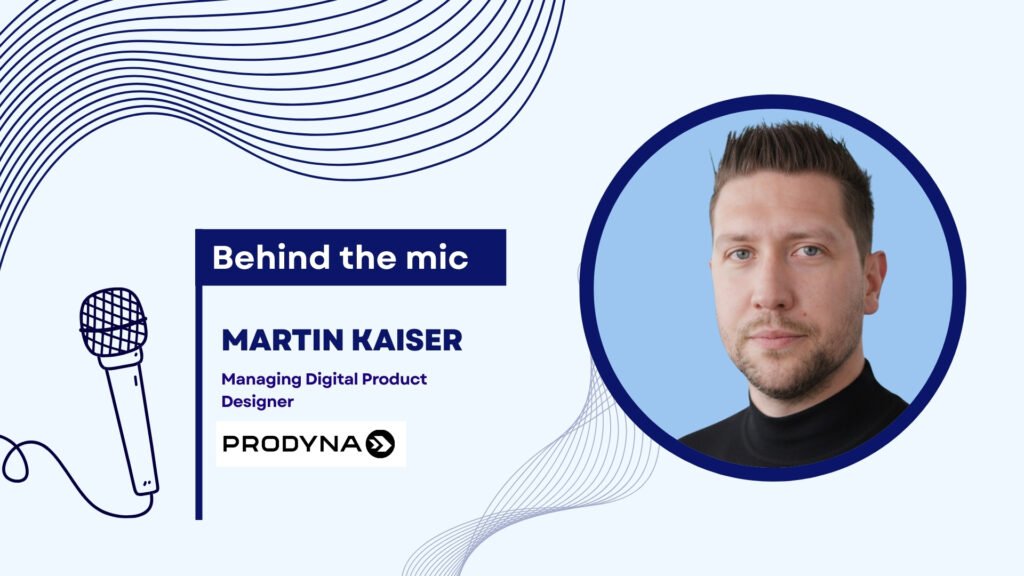
Since 2024, Martin Kaiser has been the Managing Digital Product Designer at PRODYNA SE, a system integrator that supports enterprises and larger mid-sized companies in their user, cloud, data, and AI journeys. In his role, he oversees the entire lifecycle of digital products across clients and industries. He studied Communication Design in Mannheim (Germany) and, as an Art Director Interactive, managed numerous international clients in Frankfurt-based digital agencies before joining PRODYNA in 2016.
We spoke with Martin Kaiser to discuss about human-centered AI, and the future of digital product design and, here’s his perspective.
Q1. What motivated you to pursue a career as a product designer, and what key steps did you take to shape your professional journey?
My motivation lies in the belief that for (digital) products to succeed, they must be designed around people, not technology. Early in my journey, I realized that empathy—understanding human behaviors, goals, and emotions is the key to user acceptance. In addition, I am strongly convinced that – to make product design exceptional – it requires an interdisciplinary approach. This is why I shaped my journey towards being able to leverage not only a broad range of design skills, but also insights from business across industry sectors and the latest developments in technology.
Q2. How have you leveraged emerging technologies such as AI and automation to enhance digital product experiences across PRODYNA’s clients and industries?
Our goal is to leverage AI to free employees from repetitive tasks, allowing them to focus on high-value activities. Therefore, we build custom Intelligent Business Applications that are designed to be integrated seamlessly into existing digital environments. A core part of this work is creating Unified Interfaces where humans and AI agents collaboratively work together.
Q3. What are some of the most significant challenges you've faced in introducing AI agents into hybrid human–AI teams, and how did you overcome them?
The most significant challenges are user frustration and a lack of trust when AI systems are non-transparent. We overcome these by prioritizing agent explainability, robust error management, and clear ethical risk mapping (covering bias, transparency, and privacy). We also use Job Role to AI Agent
Mapping to ensure roles are clearly defined, reducing friction in team collaboration.
Q4. What role does user feedback play in designing collaboration models between humans and AI agents, and how do you gather and integrate these insights effectively?
User feedback is foundational; engaging users early reveals unforeseen needs and ensures agents fit naturally into workflows. Therefore, we use structured Test & Track phases featuring periodic user testing and feedback mapping. The insights from this real-world interaction data are then used to refine our UX KPIs, success metrics and to derive actionable items that are fed back into product development.
Q5. What strategies have you found most effective in delivering intuitive and impactful user experiences when humans and AI systems work together?
Our most effective strategy is the rapid prototyping approach within our From Vision to Validation service as it produces a tangible result early on that is already user-validated. By using additional “Do/Don’t” language matrices and personality design, we define exactly how an agent interacts with users. This
ensures a communication framework that maintains clarity and a positive user experience even during cases of uncertainty or low-quality responses.
Q6. Could you share a success story where the introduction of AI agents, such as the “AI HR Generalist,” significantly improved team efficiency or scalability?
The “AI HR Generalist” is a flagship example of our hybrid workforce approach. By implementing an agentic system that handles repetitive tasks like initial candidate sorting, benefits inquiries, and document preparation, we enabled the human HR team to focus more on high-impact activities like culture building and employee coaching. This didn’t just speed up response time; it allowed the HR department to scale their services across a growing international workforce without a proportional increase in headcount.
Q7. Which methodologies or frameworks do you use to prioritize features and interactions when designing systems that support both human and AI contributions?
We utilize a Prioritization Matrix during our ideation workshops to rank features based on their impact and feasibility. We also apply a Jobs-to-be-Done (JTBD) approach to inventory tasks and identify high-impact opportunities for AI augmentation that align with business priorities.
Q8. How do you collaborate with cross-functional teams such as engineering, data science, product, and business stakeholders to ensure seamless integration of AI agents into daily operations?
Our UX team works cross-functionally, integrating insights from business, technology, and user-driven design. We facilitate interdisciplinary workshops
involving key business stakeholders and end users to ensure shared vision and goal alignment. This ensures that technical AI capabilities are always mapped to practical user needs.
Q9. How do you balance innovation in AI-enabled design with the need to maintain clarity, trust, and usability for end users?
We use a Responsible AI checklist and Governance frameworks to ensure every innovation is sustainable and safe. We balance “new” with “reliable” by creating UX-informed prototypes that follow a strict agent design strategy, ensuring that features like explainability and compliance measures are built-in from day one.
Q10. What best practices have you implemented to enhance UX in hybrid workforces, particularly around role clarity, interaction design, and trust building between humans and AI agents?
Key best practices include:
• Role Mapping: Validating task mapping based on user insights to identify where AI adds the most value.
• Behavioral Rules: Defining clear personality and tone guidelines for the agent to ensure consistent interactions.
• Fallback Mechanisms: Establishing clear paths for when the AI is uncertain to reduce user frustration.
• Transparency: Incorporating explainability so users understand why an AI agent made a specific recommendation.
Q11. How do you stay updated with the latest trends and developments in AI driven design, human–AI collaboration, and digital product innovation?
We stay ahead of the curve by blending external community engagement with rigorous internal research and real-world application. Our strategy includes:
• Active Ecosystem Participation: We don’t just observe; we participate in the Cloud Native Computing Foundation (CNCF) and maintain strategic partnerships with leaders like Microsoft. This gives us early access to the infrastructure and AI tools that will power the next generation of digital products.
• Internal R&D and “Mental Model” Research: We conduct dedicated internal research into the mental models of the Agentic Age. Based on a wide range of industries from our client portfolio we can compare results from our conducted user tests and user-validated prototypes. This helps us understand how human psychology shifts when interacting with autonomous agents versus static software, allowing us to refine our Experience-Driven Development (XDD) methodology accordingly.
• AI Envisioning Workshops: We use our own client-facing workshops as a laboratory. By facilitating these sessions, we identify emerging pain points and “weak signals” in the industry, which allows us to pivot our design strategies before they become mainstream demands.
• Cross-Pollination of 25 Years of Expertise: We leverage our quarter century legacy in enterprise software to filter “hype” from “utility.” We host internal Tech Talks and Hackathons where our designers and engineers
pressure-test new AI frameworks against the complex security and scalability requirements of our enterprise clients.
• Thought Leadership Feedback Loops: By delivering keynotes and webinars on the AI Hybrid Workforce, we engage with a global community of experts. The feedback and discourse from these high-level interactions serve as a critical validation for our evolving design principles.
Conclusion
Martin’s perspective highlights a fundamental shift in digital product innovation—moving from technology-driven development to truly human-centered design. His emphasis on empathy, interdisciplinary collaboration, and responsible AI shows that successful human–AI collaboration is not just about automation, but about enabling people to focus on meaningful, high-value work. By prioritizing unified human–AI interfaces, explainability, and clear role mapping, he demonstrates how trust, usability, and transparency must be embedded into AI systems from the very beginning.
“Stay tuned for more such insights from industry experts at the ‘Conversational AI & Customer Experience Summit‘ shaping the future of AI, digital transformation, and customer experience.”
Join us at Altrusia Global Events as we embark on a transformative journey
Newsletter
Copyright © 2026 Altrusia Global Events Pvt Ltd