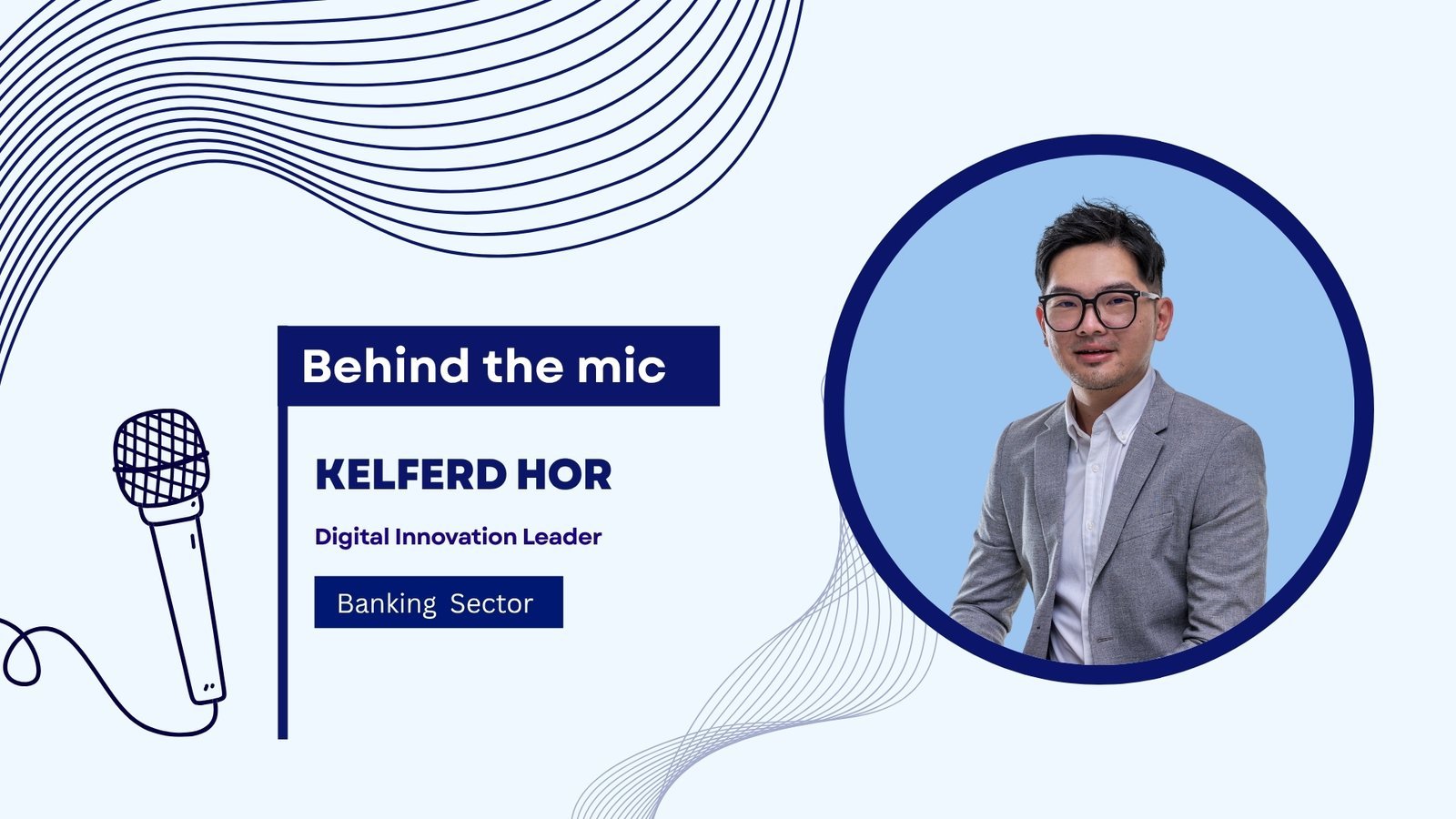
Kelferd Hor, CITP, is a Chartered IT Professional (BCS) and banking executive with over 15 years of experience in digital transformation, strategy, and innovation. He is a frequent speaker at regional conferences across Malaysia and Singapore, sharing perspectives on AI, digital banking, and emerging technologies.
He is currently a Doctoral Candidate researching a strategic framework for Generative AI in financial services, with a focus on aligning innovation with long-term institutional resilience and regulatory expectations. Kelferd also serves on the Advisory Board for eTail Asia and is an Associate Fellow of AETDEW, where he advocates for responsible innovation and measurable business impact in highly regulated industries.
In the following conversation, Kelferd Hor shares his insights on shaping the future of digital banking through strategy, data, and innovation.
Q1. What motivated you to pursue a career in digital innovation within the banking sector, and what key experiences shaped your journey over the past 15+ years?
My career has been motivated by a consistent focus on growth hacking, using creativity and innovative strategies to tackle complex business challenges and achieve rapid growth. Over the past 15+ years, I have operated at the intersection of business strategy and digital transformation. A pivotal experience shaping my journey was serving as the youngest Head of Sales at MyDeal Malaysia during the height of the daily deal craze in 2014. I was fortunate to have a boss who trusted me, empowered me to lead, and gave me the space to learn through trial and error like an intrapreneur. This role significantly honed my leadership, strategic planning, and communication skills, which continue to be essential in my current work in the banking sector.
Q2. What are some of the most significant challenges you've faced while leading digital transformation initiatives in banking, and how did you overcome them?
One of the most significant challenges in leading digital transformation initiatives in banking is balancing the need for rapid innovation with strict regulatory compliance. Banks operate in a highly regulated environment, where speed without proper governance can create substantial risk.
I addressed this by embedding compliance and risk management into agile delivery workflows, engaging key stakeholders from the conceptual stage rather than only at the end of the project. This early collaboration helped reduce rework, improve decision-making, and accelerate approvals. For example, by adopting a Minimum Viable Product (MVP) approach alongside parallel regulatory reviews, I successfully shortened the time-to-market for a customer communication tool while maintaining full adherence to internal and regulatory standards.
Q3. What role does customer insight and data play in shaping innovative banking solutions such as digital wealth management and loyalty platforms, and how do you incorporate it effectively?
Customer insight and data play a central role in shaping innovative banking solutions because they help ensure we solve real customer needs rather than assumptions. As I often use this quote, “Without data, you’re just another person with an opinion.”
I combine data analytics with design thinking to better understand customer behaviours, preferences, and pain points. In areas such as digital wealth management, these insights enable hyper personalised experiences, shifting from reactive service models to proactive engagement through relevant recommendations, timely nudges, and tailored financial solutions. For loyalty platforms, data helps us design more meaningful rewards, improve customer engagement, and increase retention.
To incorporate this effectively, I embed data driven decision making throughout the product lifecycle, from opportunity identification and solution design to performance measurement and continuous optimisation, so that innovation remains relevant, measurable, and customer centric.
Q4. What strategies have you found most effective in delivering impactful and scalable digital innovation across different banking products and services?
I have found that outcome based leadership, the ability to connect technical output directly to commercial impact, is one of the most effective strategies for delivering impactful and scalable digital innovation. Innovation should not be measured by activity alone, but by clear business outcomes such as revenue growth, efficiency gains, stronger customer engagement, and sustainable value creation.
I also focus on fiduciary innovation, which prioritises long term lifecycle integrity and strong cost to value ratios over flashy short term launches. In banking, scalable innovation must be resilient, compliant, and commercially viable over time.
In addition, building ecosystem partnerships and moving toward value co creation models has been highly effective. Collaborating with external partners allows us to access specialised expertise, accelerate execution, and deliver solutions that no single organisation could achieve alone.
Q5. Can you describe a specific instance where AI or digital innovation helped identify a major customer pain point and led to a meaningful transformation?
AI has been instrumental in identifying and resolving customer friction. One clear example was the implementation of AI chatbots to address the pain point of delayed customer support and long waiting times for routine inquiries.
By analysing conversation flows, unresolved queries, and the volume of handovers to human agents, we were able to identify gaps in customer journeys and areas where the AI required further training. These insights enabled continuous improvement of the solution over time.
The transformation allowed simple inquiries to be resolved instantly through automation, while more complex or sensitive needs were seamlessly escalated to human advisors. This created a faster, more efficient, and more personalised experience for customers, while also improving service capacity and productivity for the bank.
Q6. Could you share a success story where your work in digital innovation significantly improved customer engagement, retention, or business outcomes?
A notable success story was the development of a digital wealth management solution that received the Highly Acclaimed recognition for Excellence in Digital Wealth Management at the Global Retail Banking Innovations Awards 2024 in Singapore. In many award frameworks, winning an award is comparable to achieving an A grade, while “Highly Acclaimed” reflects near perfect scoring and exceptional distinction among finalists.
This recognition was particularly meaningful as the solution was aligned with the broader financial inclusion and financial literacy agenda outlined in Malaysia’s central bank financial blueprint, which encourages earlier and more informed investment participation among the public.
From an impact perspective, the initiative strengthened customer engagement by simplifying financial decision making and making wealth planning more accessible. Ultimately supporting better customer outcomes while reinforcing the bank’s strategic focus on responsible and inclusive financial growth.
Q7. How do you collaborate with cross-functional teams such as product, technology, or data to successfully implement innovation at scale?
Implementation at scale requires strong strategic alignment across business, technology, and data teams. I foster this alignment by conducting gap analyses with key business stakeholders and facilitating regular discussions to ensure that the technical roadmap is consistently aligned with broader organisational priorities and outcomes.
In addition, I place strong emphasis on early and continuous collaboration throughout the product lifecycle, rather than treating engagement as a handover process between teams. This helps ensure shared ownership of both problems and outcomes.
I also advocate for dedicated innovation capability that bridges financial institutions and external technology solution providers. This enables more effective ecosystem collaboration while ensuring all parties remain aligned to clearly defined success metrics and measurable business value.
Q8. How do you balance rapid innovation in AI and digital banking with the need for security, compliance, and customer trust?
I believe that innovation without security is like building the fastest car without brakes.
To maintain customer trust, I adopt a culture of responsibility guided by the BCS, The Chartered Institute for IT Code of Conduct. This ensures that ethical considerations, professional standards, and accountability are embedded into every stage of innovation.
We balance speed with safety by integrating cybersecurity as a core design principle rather than an afterthought. This includes preventive controls such as third party risk assessments, as well as detective measures like automated vulnerability testing and continuous monitoring.
For AI driven solutions, we also adhere to principles of transparency, explainability, and data minimisation to ensure responsible and ethical use of data. This helps maintain customer trust while enabling innovation at scale within a regulated environment.
Q9. What best practices have you implemented to ensure sustainable and future-ready digital transformation within the banking sector?
To ensure sustainable and future ready digital transformation, I focus on moving away from what I call “innovation tourism”, which refers to short term, award driven initiatives that are not designed for long term scalability or operational stability. Instead, I prioritise solutions that are scalable, maintainable, and aligned with long term business and regulatory objectives.
I also place strong emphasis on professional accountability and governance by encouraging accreditation and continuous professional development for digital leaders, such as the BCS, The Chartered Institute for IT certification, to ensure that those leading digital initiatives are held to recognised ethical and professional standards.
From a technology perspective, we embed Explainable AI and conduct regular model and system audits to ensure transparency, reduce bias, and maintain ongoing regulatory compliance.
Ultimately, my approach is grounded in the principle that technology should not be adopted for its own sake. The key is first identifying whether the problem is meaningful and worth solving, then applying the right solution to create measurable and sustainable value.
Q10. How do you stay updated with the latest trends and developments in AI, fintech innovation, and digital transformation across the region?
I adhere to the principle of “never stop learning” as a core part of my professional mindset.
I stay current through a combination of academic, industry, and practical engagement. From an academic perspective, I am pursuing a Doctorate in Business Administration (DBA) focused on Generative AI, which allows me to continuously deepen my understanding of emerging technologies and their application in financial services.
From an industry standpoint, I actively participate in regional conferences across Malaysia and Singapore, and serve on advisory platforms such as eTail Asia, which provides exposure to evolving fintech and customer experience trends.
In addition, I continuously monitor market developments and customer behaviour trends to ensure insights remain relevant and actionable in real time.
I also maintain professional certifications such as Certified Generative AI Specialist (CGAI™), Certified in Cybersecurity which helps ensure my knowledge remains current and aligned with global best practices in AI, Risk and digital transformation.
Conclusion
In this insightful Behind the Mic conversation, Kelferd Hor offers a grounded and strategic perspective on what it truly takes to drive digital innovation in the banking sector. His approach goes beyond adopting the latest technologies, focusing instead on aligning innovation with measurable business outcomes, regulatory integrity, and long-term sustainability. From embedding compliance into agile workflows to leveraging data for hyper-personalised experiences, his insights highlight the importance of balancing speed with responsibility in a highly regulated environment.
As reflected throughout this discussion, innovation in financial services is not just about transformation for the sake of change, but about creating meaningful, scalable impact that enhances customer trust and engagement. Kelferd’s emphasis on outcome-based leadership, ecosystem collaboration, and continuous learning reinforces a key message—successful digital transformation is built on strong foundations of strategy, governance, and customer-centricity.
“Disclaimer: The views and opinions expressed in this article are those of the author and do not necessarily reflect the official policy or position of any employer or organization.”