

Unlocking Better Customer & Employee Experiences on Behind the Mic with Sourabh Mukherjee from Ipsos
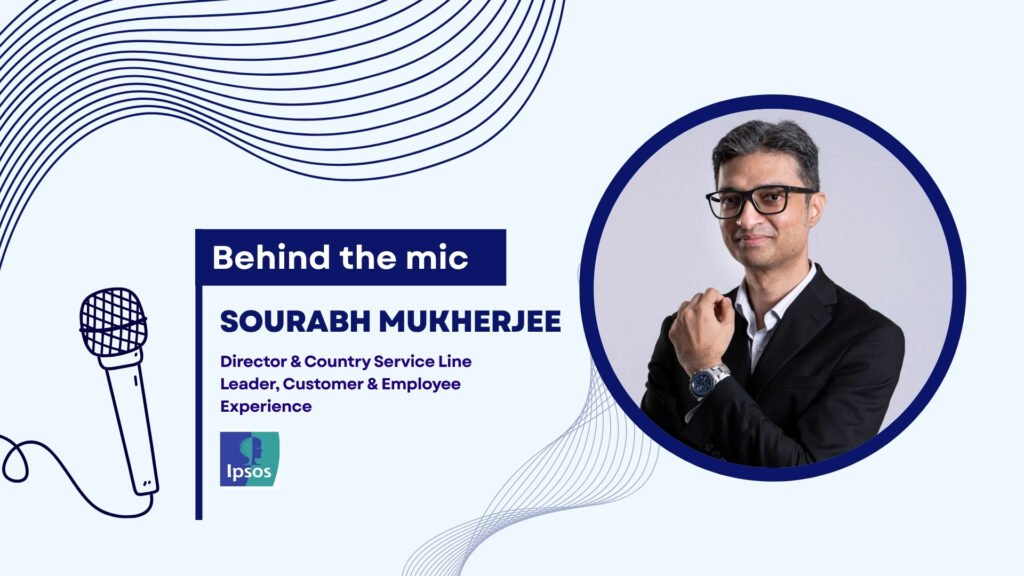
Sourabh Mukherjee is a Mechanical engineer and an MBA in International Business. His first stint came with a leading Pvt sector bank in India. After which, he hopped onto mainstream Consumer Insights & Consultancy and felt at home. Since then, he has amassed 14Y+ years of experience across multiple research disciplines and diverse sectors.
Currently, as the head of Customer and Employee Experience at Ipsos Malaysia,he drives data driven strategic decisions for his clients.
Sourabh quest for uncovering universal patterns, continues.
Sourabh Mukherjee shares his expertise on leveraging research, analytics, and AI-powered solutions to build experiences that deliver both value and impact.
Q1. What motivated you to pursue a career in customer and employee experience, and what key experiences shaped your journey from banking to consumer insights and consultancy?
It may come as a surprise, but Market Research happened to me in 2011 through a “process of elimination of other career options in hand.” After a brief stint in banking from 2006-09, and during my MBA days (2009-11), I was inspired by ‘Holland’s personality job fit theory’ [RIASEC] in an Organisational Behaviour lecture. Drawing on my nature of being Realistic, Investigative, and Creative, Market research suited me best as it was sitting at the intersection of Art & Science.
Q2. How have you leveraged data, analytics, and emerging technologies such as AI to drive customer and employee experience strategies for your clients?
Ipsos has announced its strategic plan ‘Horizons’, aimed at boosting its growth and margins by 2030. The goal is to transform the company into an “AI – augmented Global Market Research leader”. We are already ahead of the curve with HI + AI-powered solutions in the EX/CX space, including CX Persona Bot, CX Gen AI Signals, and AI-assisted workshops.
Q3. What are some of the most significant challenges you've faced in translating research insights into actionable business decisions, and how did you overcome them?
Some frequent challenges that occur are due to the lack of awareness of how the internal vs external surveys differ. This reinforces the importance of having sound judgement in research design, sampling and alignment with research objectives at the start of the survey. There is also a common tendency to extract everything from the same survey, which often dilutes the purpose of individual studies.
Q4. What role does customer and employee feedback play in shaping experience strategies, and how do you gather and incorporate it effectively?
This brings us back to how intricately both Customer and Employee Experiences are linked together. When employees’ core relational needs are met, they are significantly more likely to exhibit positive behaviour towards customers and forge healthy relationships. It remains therefore crucial to invest in creating strong relationships with employees, so that they are more likely to be able to do so with customers and ultimately yield higher business outcomes.
Q5. Can you describe a specific instance where research insights helped uncover a critical pattern or pain point and drove impactful change?
This occured during a bank survey last year, where a client’s hypothesis was that the launch of new app would significantly improve satisfaction across its broader customer base. Initial internal survey results indicated that the app had received a very good reception; however, when external survey results came out, it showed that the app was still lagging behind the competition. We discovered that less tech-savvy customers were still struggling with adapting to the new ways of transacting and to the UX of the app. Additionally, for some customers, the migration process was still pending, resulting in inconsistent performance across the overall customer base. Timely and regular updates, awareness communications, and tutorial resources would have been the ideal solution.
Q6. Could you share a success story where your work significantly improved customer satisfaction, employee engagement, or overall business performance?
We have been proud partners of TNB for its Corporate reputation and CSI programs since pre-COVID. TNB achieved a high Customer Satisfaction Index (CSI) score of 9.0 in 2025 – its highest result ever, reflecting sustained efforts to enhance service quality and customer experience.
Q7. Which methodologies or frameworks do you use to analyze experience data and ensure alignment with business goals?
We apply the principles of ROCXI analysis- “Return Of Customer Experience management”. It is a powerful data integration technique that quantifies the link between survey KPIs and business or financial outcomes. It provides evidence to justify expenditure and make the Customer Experience a higher priority. Different financial outcomes include reducing churn, improving advocacy, retaining at-risk customers, and improving operational efficiency.
Q8. How do you collaborate with cross-functional teams such as marketing, HR, operations, and leadership to ensure insights are effectively translated into action?
We begin with the ‘Engage’ phase, where we gather inputs from senior stakeholders on the overall vision, customer journeys, products, touchpoints, and OPS in the current design, and also set survey expectations/ hypotheses so that we can get the design right. After the dissemination of results and insights, we conduct activation workshops where our clients receive context and guidance from us before drafting and prioritizing their action plans.
Q9. How do you balance quantitative data with qualitative human insights to create a holistic understanding of customer and employee experience?
Both methodologies have co-existed since the foundational years of research. Quantitative data is seen to be structured, close-ended, KPI driven, and hypothesis validation ‘What’ exercises. However, Qualitative data is used primarily to understand the ‘Why’
Q10. How do you stay updated with the latest trends and developments in customer insights, experience management, and data-driven decision-making?
We are a close-knit community of researchers within Ipsos. We leverage our global presence across 90+ markets, sectors, and client relationships. We also have platforms to share wins and best in class insights on a regular basis, in addition to the global trackers that we run such as ‘What Worries the World’ and ‘Consumer Confidence Index’.
Conclusion
As our conversation with Sourabh Mukherjee comes to a close, one theme stands out clearly: meaningful customer and employee experiences are built at the intersection of data, human understanding, and purposeful action. From his unconventional journey into market research to leading Customer & Employee Experience at Ipsos Malaysia, Sourabh highlights the importance of balancing analytical rigor with empathy, ensuring that insights translate into tangible business outcomes.
His perspectives on AI-augmented research, the connection between employee engagement and customer satisfaction, and the need for thoughtful research design offer valuable lessons for organizations navigating an increasingly complex experience landscape. As businesses continue to embrace digital transformation, Sourabh’s approach serves as a reminder that while technology can amplify insights, it is human judgment, curiosity, and collaboration that ultimately drive meaningful change.
“Stay tuned for more exclusive conversations with ASEAN’s leading voices in AI, customer experience, digital transformation, and innovation as we continue our Behind the Mic series.”
Join us at Altrusia Global Events as we embark on a transformative journey
Newsletter
Copyright © 2026 Altrusia Global Events Pvt Ltd