As AI continues to reshape customer and candidate experiences, building successful products requires more than adopting the latest technology. It calls for a clear understanding of user needs, thoughtful product strategy, and a commitment to responsible innovation.
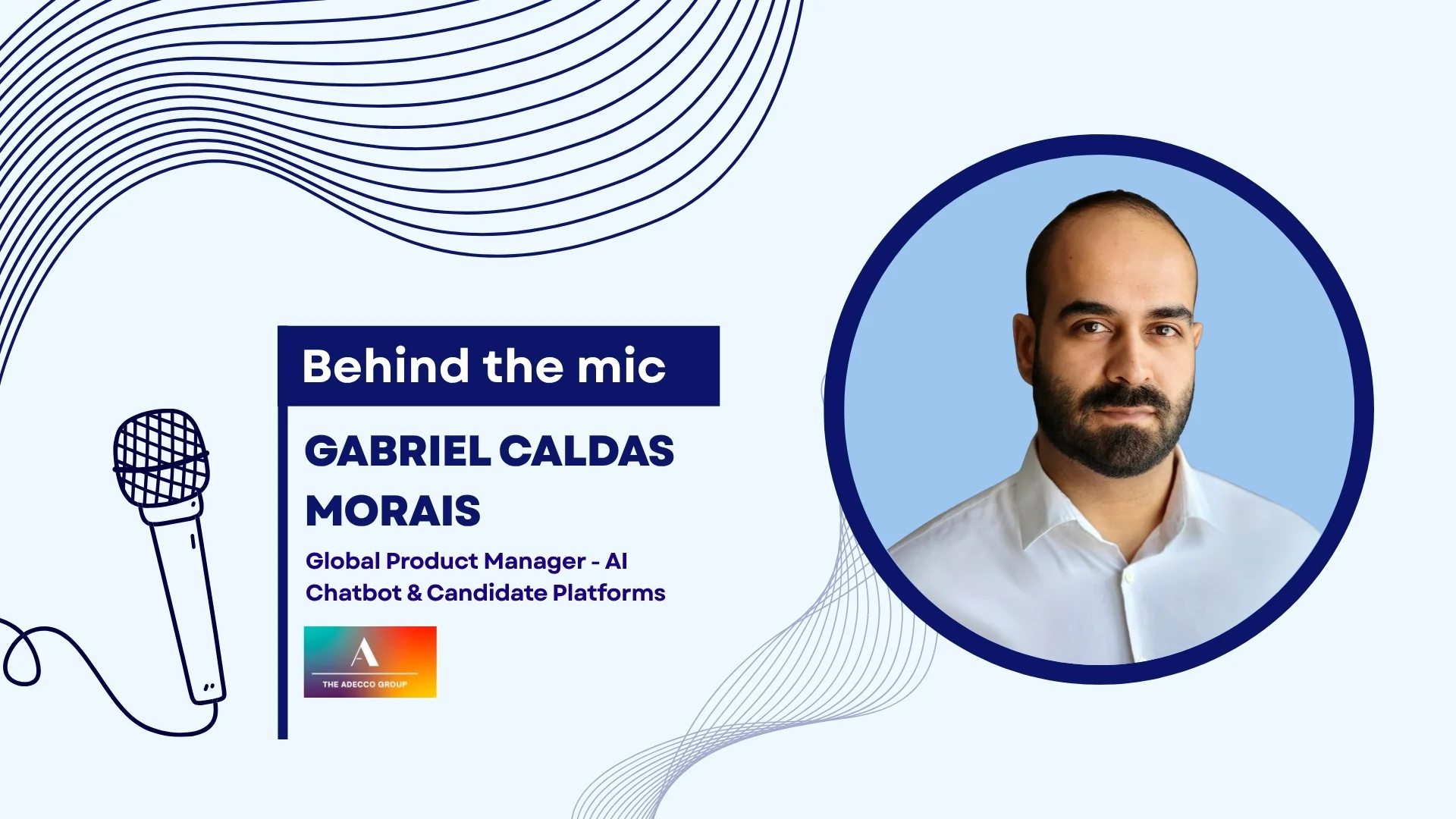
In this edition of Behind the Mic, Gabriel Caldas Morais, Global Product Manager – AI Chatbot & Candidate Platforms at The Adecco Group, shares his perspective on turning AI capabilities into meaningful product improvements. From scaling AI-powered recruitment experiences and navigating ethical challenges to balancing experimentation with human oversight, he explores what it takes to build AI products that deliver real value for both users and businesses.
Q1. What motivated you to build a career in digital product management, particularly across industries such as finance, retail, and HR Tech?
I’ve always been fascinated by how technology changes people’s lives. As a millennial, I watched entire routines being reshaped because of a new piece of tech or digital product. I wanted to be part of that, building and making the best use of it to create impact. And impact with scale.
Product management gave me that seat: close to technology, close to business, but anchored on the user needs. And users only stay when the product truly improves something for them.
Complex industries like finance, retail, and HR Tech have hard problems, heavy regulation, and a lot of room to create and scale real impact.
Q2. How have emerging technologies, particularly AI, influenced the way you approach product strategy and development?
Emerging technologies always need to be evaluated, but it does not always deserve a place in product strategy.
AI, on the other hand, has passed through the curve of disillusionment. For me it shifted two things for the product strategy:
- First, the final users are much more demanding on finding what they want. They have also been exposed to GenAI and easy access to information. Our product needs to adapt to that;
- Second and most insightful, AI Agents can also be users. Not every agent is a threat. For example, if I have a recruitment tool to schedule interviews, and now I brought a new agent, I could combine them.
On the delivery side, code documentation, and even code generation have raised the bar for everyone. Me included. A good team empowered with AI can do so much more.
Q3. What are some of the most significant challenges involved in building and scaling AI-powered products across different markets and user groups?
One thing is to clearly define the expectations. New technologies come with a lot of excitement around it. But we need to be careful and realistic. Every extra step or decision given to an agent reduces its accuracy.
Second, ethics. In high impact industries, like HR-Tech it is imperative to avoid amplifying existing bias. Having corporate AI principles has been very helpful. For example, if a candidate asks an agent for job openings for a given ethnicity, the agent should never present stereotyped jobs.
Scaling to different markets often involves calibrating the responses for questions like this one. In Australia, hiring candidates from the Aboriginal population is a necessary inclusion policy. In Europe, filtering by ethnicity is discrimination. Similar criterion, opposite meaning.
Once passing through these gates, there are still challenges. A close involvement with local experts and briefing them on the technology, its use cases and limitations, before asking for their validation, becomes an important step.
Q4. What strategies have you found most effective for ensuring AI products address real user problems while also delivering measurable business value?
The most effective strategy is elegant in its simplicity and very efficient for AI adoption. It consists of applying it to existing journeys that already address users’ problems.
Just like Kaizen and other industry principles, there is always room for improvement. For example, a website-based FAQ bot, already answering structured queries, can be upgraded by a GenAI-based FAQ bot, enabling natural language queries. One can compare the performance before and after AI in terms of satisfaction and deflection.
Later, it can be enabled with intent recognition, linking some queries with further journeys. You add triggers on the conversation for other journeys and start capturing new success factors. For example, measuring how many clicks on job links came from a conversational job search.
Q5. Could you share a success story from your experience scaling a digital or AI product, and the key factors that contributed to its impact?
I worked as a digital channel Product Manager for a Fintech back based by a huge retailer in Brazil. We went from launch to 1MM bank accounts in 6 months. An astonishing achievement for the market.
The company already had a licence to sell credit cards and were looking for a new license to operate as a full bank.
The challenges for launching a mobile bank were more than a legal approval. Due to KYC and credit models, middle executives wanted to collect as much information as possible from the customer since the very first interaction.
As the Product Manager responsible for the onboarding, I needed to influence business and legal to reduce the journey complexity.
The three factors that contributed for most of the success were:
First, a strong user research. I recruited the UXers to do a high-fidelity prototype; meanwhile, the team's engineers were preparing the systems foundation. We all went to the field. We recruited 60 users, among card holders and non-clients. We presented for a control group with a longer onboarding as required by business and legal, where the user provides every requested data and document, and by the end would have all the benefits we could offer.
The test version was a shorter onboarding, allowing users to have a simple transaction account, but without further benefits. To upgrade to a full benefits account, they had to provide documents for verification.
We realized that 1/2 of users on the short version would be willing to upgrade. On the other hand, only 1/3 on the long version users would complete the account registration process. The churn was simply not worth it to collect all the data at once.
Second success factor, close alignment with legal. In validation with legal, we understood the minimum required data needed for a simple transaction account. We then realized that the approval for a transaction account bank was much simpler than for a full bank account.
This final legal tip we captured with our validation contributed to unblock business push back on the simpler account. Choosing the short version also reduced uncertainty with the launch date that was also a priority. All meanwhile still compliant. Besides that, the "upgrade account" feature could be enabled as soon as the full bank approval was granted.
And the third factor was partnership with other divisions of the holding, like the existing credit card. A strong feature was that paying the card bill with our account would free the credit for immediate use. This brought several card holders to the bank.
In the end, it was clear that it’s easier to upgrade a user you brought in easily than to overwhelm a new user with requests. Reduce friction first; keep the engagement, ask for more later. Today, and with several other onboarding improvements, the bank has over 6 million full accounts.
Q6. How do you balance innovation and experimentation with the need to deliver reliable, scalable, and responsible AI experiences for job seekers?
It is tempting to add new features and use cases from new model innovations. My first move is to resist it, and second to identify where to apply guardrails. Potential users' feedback collected during testing can be a great thermometer to identify risky interactions.
Even a simple FAQ bot needs guardrails: it's exposed to user input, there's no manual, and people can ask about competitors or politics, where the answer could compromise the company image. The design principle is simple: anything beyond company scope, the bot says so and educates the user not to insist. Saying 'no' is part of the product.
For job seekers, the stakes are higher. I can't go into the specifics of our agents, but I can tell you the principle: AI can support, never decide. Final decisions about candidates are always made by a human. That's not just good practice — it's what GDPR and the EU AI Act require.
Q7. How do you stay updated on developments in AI, product management, and recruitment technology, and identify which trends are worth turning into product opportunities?
A tip would be joining in events like this one. The exchange and inspiration we get by being with professionals outside our industry bubble is also important. I was in Shanghai last month to follow closely what local start-ups were presenting and I came back quite inspired.
Newsletters and articles, for example Product Tank and Nielsen and Norman group and other established consultancies also makes me aware of new use cases.
My filter starts with an analogy. A solution that addresses real problems somewhere else, same structure, different domain, can be mapped with problems on my jobs-to be-done list. One of the most important abilities to thrive innovation is to create mental links on how a solution designed to solve a specific industry issue, can also be the solution for our industry issues. Example, operating rooms for medical surgery were inspired by the F1 pit stop dynamics - coordination under pressure.
I then organize with the team a spike to evaluate feasibility and plan a POC whenever possible. This combined with user’s feedback and/or captured pain points from researches and surveys, help me to understand the relation value Vs effort. If worth it, we go from POC to pilot. From pilot to scale.
Conclusion
Building smarter AI products starts with solving the right problems, setting realistic expectations, and keeping people at the centre of every decision. As Gabriel highlights, responsible AI is not just about what technology can do, but also about understanding its limitations, establishing the right safeguards, and ensuring that innovation translates into measurable outcomes.
His insights offer a valuable reminder that successful AI adoption is an ongoing process of learning, testing, and improvement. As AI continues to evolve, the focus must remain on creating experiences that are useful, trustworthy, and designed around real human needs.
"Stay tuned for more conversations with industry leaders in our Behind the Mic series, where we explore the ideas and experiences shaping the future of AI and customer experience".