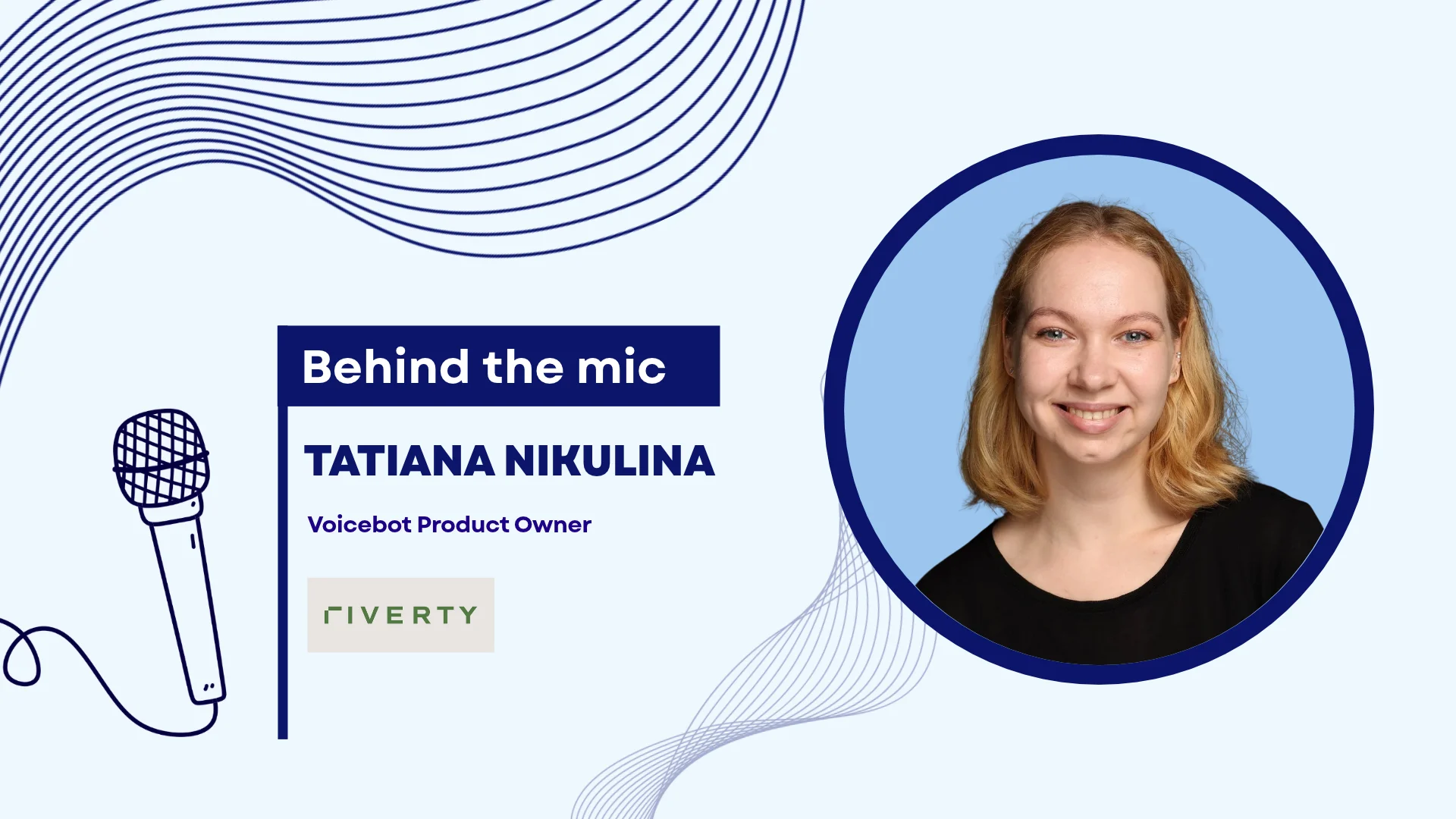
Voice AI is changing how organisations approach customer service, moving beyond traditional IVR systems towards more intuitive, conversational experiences. But as automation becomes increasingly sophisticated, an important question remains: how can businesses make these interactions genuinely helpful while maintaining the human connection? Tatiana Nikulina works on exactly that problem. As Voicebot Product Owner at Riverty, she leads the evolution of voice automation in fintech, from traditional IVRs to conversational AI, connecting technology, business processes and customer needs. In this edition of Behind the Mic, she shares what she has learned about building voicebots that help people move forward, and about knowing when to step aside for a human agent.
A first point of contact with real responsibility
For Tatiana, one of the most interesting aspects of product management in conversational AI is the complexity of the challenges involved. Customer expectations continuously evolve, multiple stakeholders need to be aligned, and solutions must adapt to changing business and operational requirements. "The voicebot is often the first point of contact in the voice channel," she says. "That comes with a real responsibility towards our consumers. In fintech, people call us with issues that often need to be addressed in a timely manner, and being able to provide support around the clock, even if only for certain types of queries, can make a real difference." That responsibility shapes how Riverty approaches design. Its customers range widely in digital literacy and familiarity with AI assistants, so conversation flows have to be intuitive for everyone. Trust matters even more in sensitive situations such as debt collection, where consumers may feel uncertain or overwhelmed. "Our role is not simply to automate an interaction or maximise deflection," she explains. "It's to guide people through the process in a clear, supportive, and empathetic way, helping them regain confidence and feel more in control of their finances."
A partner to human agents, not a replacement
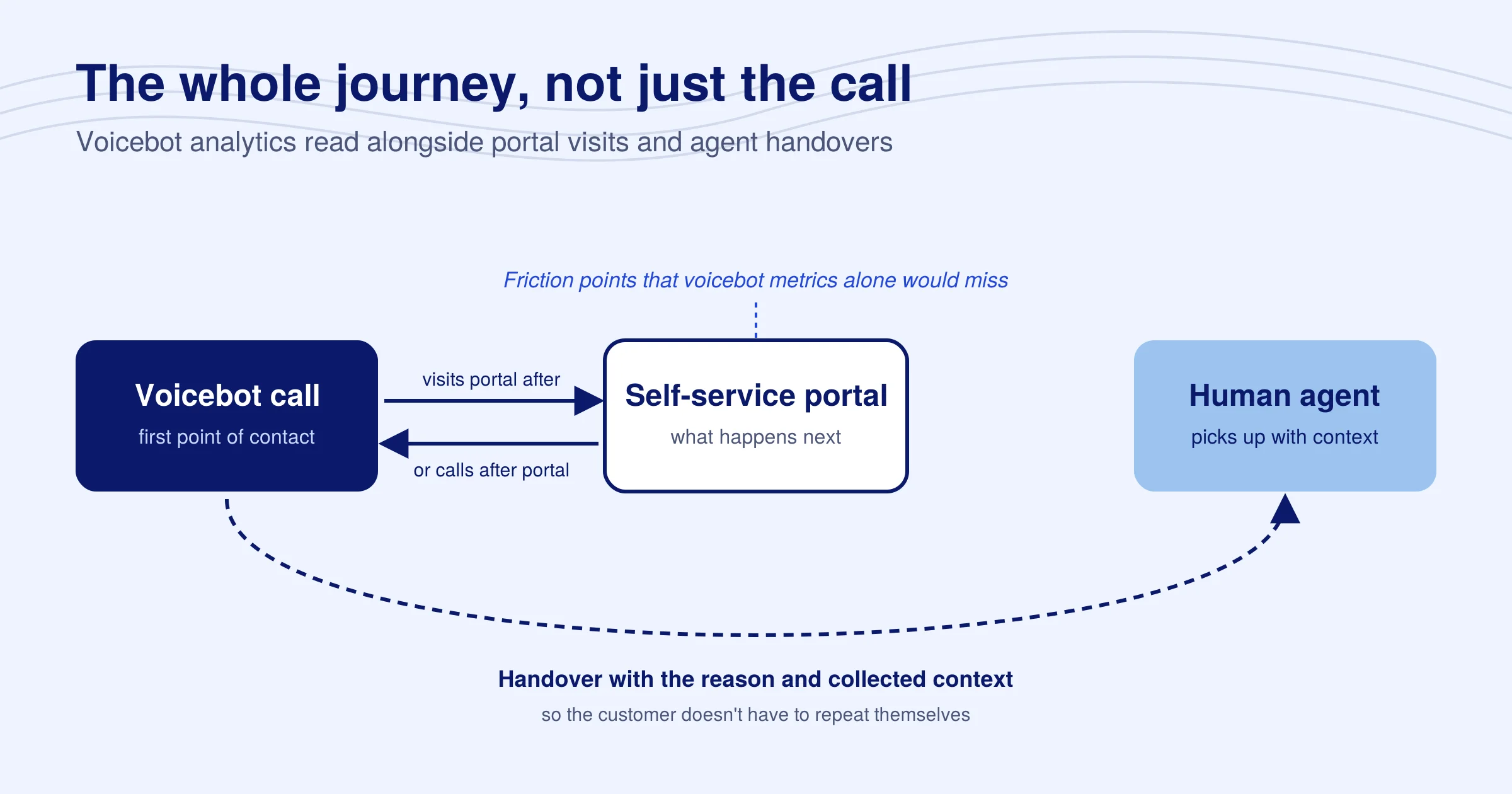
One principle runs through much of Riverty's voicebot design is that automation is not the goal itself. "We see the voicebot as a partner to our human agents, rather than a tool that should automate every interaction at all costs," says Tatiana. In practice, this means deciding in advance when the bot should hand over. Certain invoice statuses, for example, limit what the voicebot can offer and often point to more complex cases. When the backend identifies one of these, the call can go straight to an agent, without waiting for the consumer to grow frustrated or ask for a person. The handover itself is treated as part of the experience. Before transferring, the voicebot collects relevant information so the consumer does not have to repeat themselves and the agent can pick up with context. The reason for the transfer is also explained to the caller. "Transparency is one of our core values," she notes, and it helps the transition feel natural instead of leaving customers wondering why the bot can no longer help. The same transparency applies at the start of the call. Riverty makes it clear that customers are speaking with AI and always provides a route to a human. Follow-up communication through other channels completes the picture, aiming for a consistent experience across touchpoints rather than optimising each interaction in isolation.
Looking beyond the voicebot's own metrics
Riverty's team is, in Tatiana's words, "very data-driven," but the data they trust most does not sit in the voicebot alone. They analyse the wider customer journey: whether a consumer calls after using the self-service portal, or visits the portal after a call, and what they do there. Agent shadowing sessions show what information agents actually need when a call is transferred, and how they use what the bot passes along. This cross-channel view surfaced a revealing pattern. For end-to-end requests such as setting up an instalment plan or requesting a confirmation, some consumers were calling again even after the voicebot had completed the task successfully. They wanted to check that it had really gone through. "Completing a transaction wasn't always enough," Tatiana says. "Consumers also needed reassurance that everything had worked as expected." The team responded by revising the UX and wording, adding follow-up communications to make outcomes clearer, and introducing a backend check at the start of each call to see whether a request had already been submitted. If it had, the consumer is told early, and skips the standard flow. The change addressed the reason behind the repeat calls rather than treating them as a volume problem, and it moved the repeat-call metric in the right direction.
Always-on support, with limits
Round-the-clock availability is one of voice automation's clearest benefits in fintech, where people do not always want to wait for the next working day. Riverty's voicebots let consumers handle certain requests, such as receiving a copy of an invoice, at any time and without waiting for an agent. But Tatiana is careful about what that availability means. "We don't see 24/7 availability as a reason to automate everything," she says. "It's about making support more accessible while ensuring that consumers can still reach a human agent when their situation requires it." For her, the real value lies in "combining the convenience of always-on support with a clear understanding of where human assistance makes the difference."
Measuring what matters
That philosophy extends to how the team prioritises and measures its work. A backlog of ideas, feedback and issues is ranked by customer impact, business value, urgency and operational risk, with critical issues addressed immediately and priorities reviewed regularly. Success is judged against the objective of each initiative, whether that is task completion, fewer repeat calls, more effective transfers or a better overall journey. "Automation rates are useful, but they don't tell the whole story," Tatiana says. The real test is whether a change improved the experience for consumers and delivered the intended business value. Getting there takes cross-functional collaboration. Technical, operational and customer service perspectives are considered together, and the voicebot is positioned within the broader business strategy, workforce planning and tone of voice. "Ultimately, the voicebot is a customer-facing product," she says, "so its development needs to be aligned with both our business objectives and the experience we want to deliver to consumers."
Innovation with a purpose
Staying current in a fast-moving field takes market and user research, professional events and networking. Yet awareness of new technology, Tatiana says, is only the starting point. The more important question is whether an innovation solves a real customer problem or creates meaningful business value, and whether it can be implemented in a way that is reliable, scalable and consistent with a fintech's responsibilities. "Rather than adopting a technology simply because it's new, we should test its practical value and use the results to decide whether and how to scale it."
The takeaway
Tatiana's perspective points to a shift in how success in voice AI is defined. The future is not simply higher automation rates, but experiences that are accessible, reliable and human-centric: using data to find friction, designing smooth handovers between bot and agent, and being honest about where each does its best work. As voice technology evolves, the measure of progress will be its ability to solve meaningful customer problems and build trust.
“Want to hear more perspectives from industry leaders? Explore more Behind the Mic interviews and discover the latest insights shaping conversational AI and customer experience at the Conversational AI & Customer Experience Summit (CACES). Stay tuned for more!”