In this article
- The Problem With Traditional IVR: Automation Without Understanding
- The Rise of Conversational AI: From Call Routing to Problem Solving
- The Data: Why Businesses Are Replacing Traditional IVR With Conversational AI
- The Economics: Why Enterprises Are Accelerating AI Voice Adoption
- Will Conversational AI Replace Human Agents Too?
- Why Generative AI Is Accelerating the End of Old IVR
- Is IVR Dead?
- The Future of Customer Conversations: AI Agents Become the New Front Door
- FAQ's
For nearly four decades, Interactive Voice Response (IVR) has been the front door of enterprise customer service. Banks used it. Telecom companies depended on it. Healthcare providers scaled support with it. But customers rarely loved it.
The familiar experience of “Press 1 for billing, Press 2 for support” solved a business problem, but often created a customer problem. Today, that model is facing its biggest disruption yet. Conversational AI powered by Natural Language Processing (NLP), Generative AI, and intelligent AI agents is changing how businesses handle millions of customer conversations. The question is no longer:
“Can AI answer customer questions?”
The bigger question is:
Do customers still need traditional IVR at all?
The data suggests that IVR is not disappearing overnight, but the era of rigid menu-based customer service is coming to an end.
The Problem With Traditional IVR: Automation Without Understanding
When IVR systems were introduced, they solved a major scalability challenge. Companies needed a way to:
- Reduce call center pressure
- Route customers faster
- Automate repetitive requests
- Lower operational costs
For that era, IVR worked.
The problem?
Customer expectations evolved faster than IVR technology. Modern customers are used to instant digital experiences from apps, search engines, and AI assistants. They expect businesses to understand what they need immediately. Traditional IVR still depends heavily on fixed decision trees:
Customer calls. Machine asks. Customer chooses. System routes. But real conversations do not work like flowcharts. A customer does not think:
“My problem belongs to option number 4.”
They think:
“I need my problem solved.”
That gap is where Conversational AI entered.
The Rise of Conversational AI: From Call Routing to Problem Solving
Conversational AI represents a fundamental shift in customer support automation. Traditional IVR asks:
“What button did the customer press?”
Conversational AI asks:
“What is the customer trying to achieve?”
Using AI technologies like:
• Natural Language Understanding (NLU)
• Speech recognition
• Large Language Models (LLMs)
• Machine learning
• Sentiment analysis
• Real-time integrations
AI agents can understand human language, detect intent, access business systems, complete tasks, and escalate when needed. A customer can simply say:
“My last payment went through, but my account still shows overdue.”
A traditional IVR struggles because there is no exact menu option. A Conversational AI agent understands:
Intent: Payment issue
Context: Account status problem
Action: Check transaction data
Resolution: Update or escalate
This changes automation from navigation to conversation.
The Data: Why Businesses Are Replacing Traditional IVR With Conversational AI
1. Customers Are Moving Away From Menu-Based Experiences
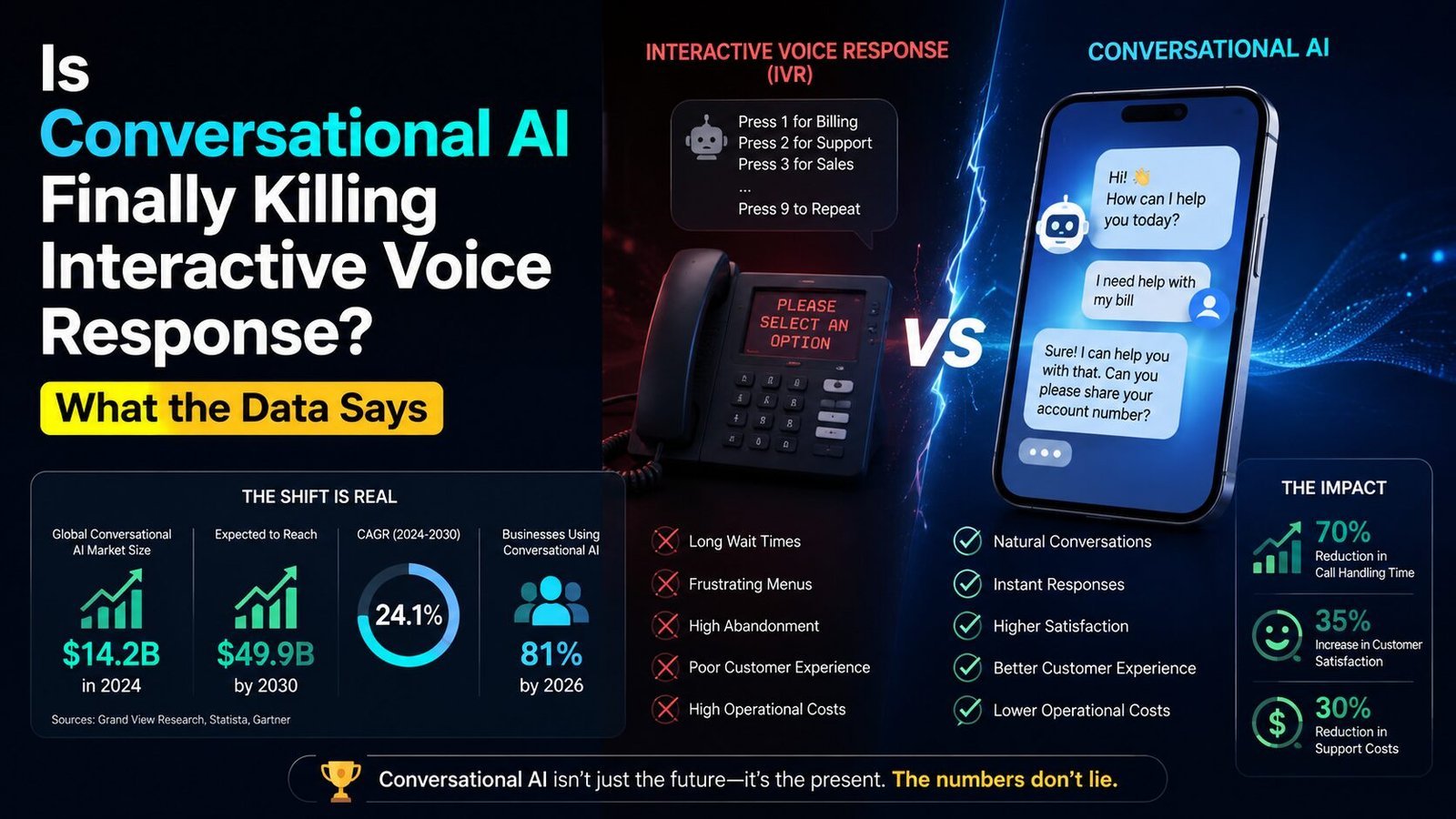
Customer expectations have permanently changed. Research shows that around 85% of customers find traditional IVR systems difficult to navigate, and many users attempt to bypass IVR completely to reach a human agent. The reason is simple. Customers do not hate automation. They hate bad automation. When automation saves time, customers accept it. When automation creates extra work, customers reject it. Conversational AI solves this by removing unnecessary steps. Instead of:
Press 1. Press 3. Enter account number. Repeat details to agent. The journey becomes:
“How can I help you today?”
2. Conversational AI Delivers Higher Automation Rates
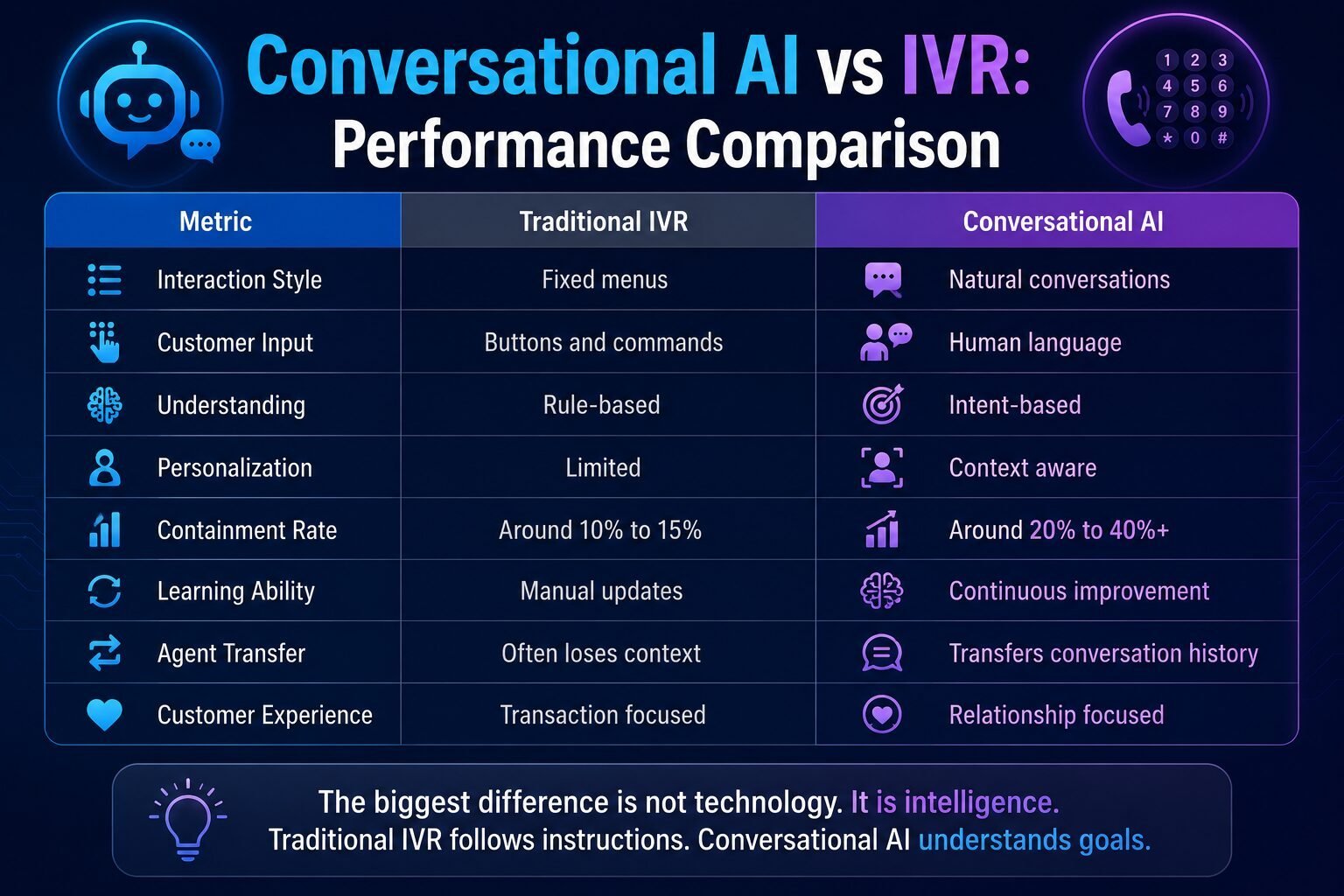
One of the strongest indicators of IVR disruption is containment rate. Containment rate measures how many customer issues are resolved without requiring a human agent. Industry benchmarks show:
Traditional IVR:
Approximately 10% to 15% containment
Conversational AI IVR:
Approximately 20% to 40% containment, with higher results for optimized use cases
For repetitive customer requests, AI performance can be significantly higher. Examples include:
- Order tracking
- Refund updates
- Appointment scheduling
- Password resets
- Account information
- Payment queries
These are not conversations where customers necessarily want a human. They want speed. AI delivers that.
The Economics: Why Enterprises Are Accelerating AI Voice Adoption
Customer experience is only one part of the story. The business case is equally powerful. Contact centers handle millions of repetitive interactions every year. Every unnecessary human-assisted conversation creates additional cost. Research comparing service channels shows a dramatic difference: Self-service interaction:
Around $0.10 per interaction
Human-assisted support:
Multiple dollars per interaction
At enterprise scale, even a small automation improvement creates a major financial impact. Example:
A company receiving 1 million support calls per month.
If Conversational AI resolves only 30%: 300,000 fewer repetitive agent conversations. That means:
- Lower support costs
- Shorter waiting times
- Higher agent productivity
- Better customer experience
This is why AI adoption is becoming a boardroom conversation, not only a customer service upgrade.
Will Conversational AI Replace Human Agents Too?
A common misconception is:
“AI replacing IVR means AI replacing humans.”
The data suggests something different. The future contact center is not AI versus humans. It is AI plus humans. AI agents handle:
- Repetitive questions
- High-volume requests
- Simple transactions
- 24/7 instant support
Human agents handle:
- Emotional situations
- Complex decisions
- Relationship management
- High-value conversations
The best customer experiences will come from combining AI efficiency with human empathy.
Why Generative AI Is Accelerating the End of Old IVR
Earlier voice bots had limitations. They needed strict scripts. They failed with unexpected questions. They struggled with natural conversations. Generative AI changed this. Modern AI agents can:
- Understand different sentence structures
- Summarize conversations
- Detect customer emotions
- Generate personalized responses
- Connect with CRM systems
- Complete multi-step workflows
This moves customer service from reactive support to proactive assistance. Future AI agents will not just answer questions. They will predict customer needs.
Is IVR Dead?
No. But traditional IVR is becoming outdated. The future will not be:
Press 1 for support.
It will be:
“How can I help you today?”
Businesses will still need voice automation, routing, compliance, and escalation. But the intelligence layer is changing. IVR was built for call management. Conversational AI is built for customer relationships. That difference explains why enterprises are investing heavily in AI-powered customer experiences.
The Future of Customer Conversations: AI Agents Become the New Front Door
The next generation of customer service will be:
- Always available
- Personalized
- Context aware
- Multichannel
- Powered by AI agents
- Connected with human teams
The companies that win will not be the ones that simply automate more. They will be the ones that make automation feel effortless. Traditional IVR helped businesses handle conversations. Conversational AI helps businesses improve them. And that is why the biggest transformation in customer service is not replacing humans. It is replacing outdated experiences.
FAQ's
Is Conversational AI replacing IVR?
Conversational AI is replacing traditional menu-based IVR experiences by allowing customers to interact naturally through voice and text. Many businesses are moving from fixed call flows to AI-powered voice agents.
Why is Conversational AI better than traditional IVR?
Conversational AI understands customer intent, maintains context, personalizes responses, and resolves issues without forcing users through complicated phone menus.
Will AI voice agents eliminate call centers?
AI voice agents are unlikely to eliminate call centers completely. Instead, they automate repetitive interactions while human agents focus on complex customer needs.
What industries benefit most from Conversational AI?
Industries with high customer interaction volumes benefit the most, including banking, insurance, telecom, healthcare, ecommerce, travel, and financial services.
What is the future of IVR?
The future of IVR is intelligent voice automation powered by Conversational AI, Generative AI, and connected AI agents rather than traditional keypad-based menus.
See it in practice
Hear the people doing this work at Conversational AI & CX Summit Europe.
Munich, 28–29 October 2026